The Bitcoin banks are coming!

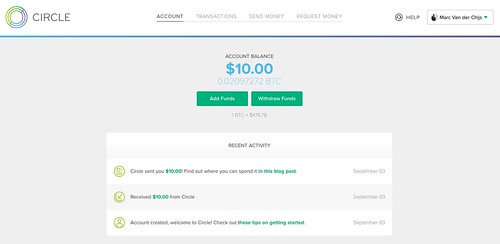
Circle $10

Yesterday I was excited to see that Goldman Sachs and IDG (Tudou’s first investor) invested in Circle.com’s $50 million round. Having Goldman on board is a major milestone, they are the smartest kids on the block and when they invest in Circle it means they start to believe in Bitcoin and the blockchain. IDG is also an important company to have as an investor, because with their Chinese connections they should be able to open a lot of doors in China for Circle.

Circle wrote a blog post about the investment and from that article it becomes clear what they are planning to do. They are not just a bitcoin exchange and wallet anymore, but they are slowly becoming a bank. So far you could only hold Bitcoin on their platform, but now you can also hold your money in USD, just like on a normal bank account. And you can transfer this money to other Circle accounts (in USD or in BTC) much faster and cheaper than you could do it through a normal bank.

And because Circle plans to enter China, it means that you will eventually be able to put Chinese RMB on your Circle account and transfer that in seconds to a USD account in the US (or any other country where Circle will be active). This is a major step in the disruption of the remittance industry. I am surprised that the Western Union stock only went down 0.5%, after this announcement, I would be very worried as a WU stockholder.

But also banks should watch out because an important part of their business can be gone in a matter of 2-3 years. And it won’t be just the remittances: if people transfer money they normally leave part of it on their accounts, which is then used to lend out to other bank customers and to create new money by fractional reserve banking.

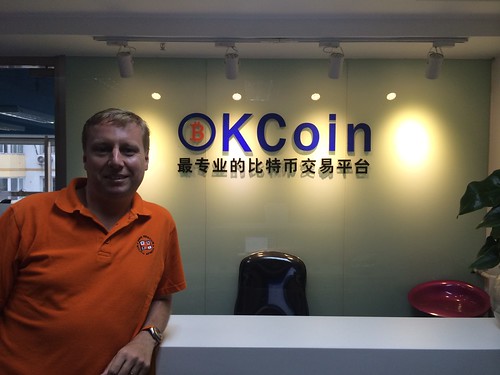
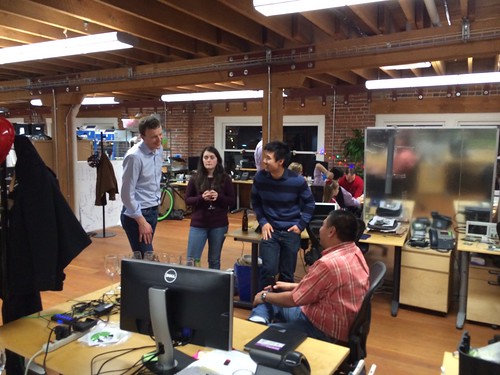
OKCoinVisiting the OKCoin office in June 2014

The superwallet that Circle created is actually not the first in the world. China’s leading exchange OKCoin launched a similar product a couple of days ago, but it did not get as much press as the Circle announcement (full disclosure: my wife is an advisor to OKCoin). OKcoin also lets you do cheap and fast international transfers and allows you to hold USD, RMB or BTC in your wallet. So in the Chinese market they are far ahead of Circle, because Circle can’t offer RMB yet.

The blockchain is an excellent mechanism to replace the old way of transferring money, and soon there will be a lot of other companies doing international remittances using Bitcoin technology (e.g. Melotic is already doing this, and Abra and ZipZap will launch in the near future). How many of these companies will also allow you to hold multi-currencies in wallets remains to be seen, but it’s clear that Circle and OKcoin are the first Bitcoin companies that are evolving into bank-like institutions with bank accounts and remittances.

OKCoin is actually a lot closer to a traditional bank already, in the sense that you can do more than just hold and send money. OKCoin now already offers futures, margin trading and even P2P lending. They still operate a bit under the radar for most people outside China, but I think they are quietly growing into a financial giant. The Bitcoin banks are coming!

Initial impressions of the Apple Watch

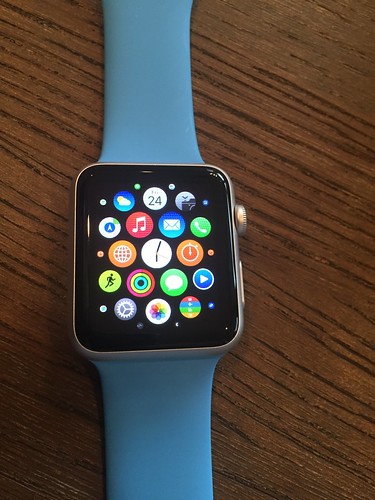
My Apple Watch

For the past 2 days I have been wearing my new Apple watch, the 42mm sports model. I decided to buy just the basic model because, except for sports, I didn’t think I would wear it a lot. The main reason for buying it was to understand the device and its capabilities, so I can better spot potential business and investment opportunities.

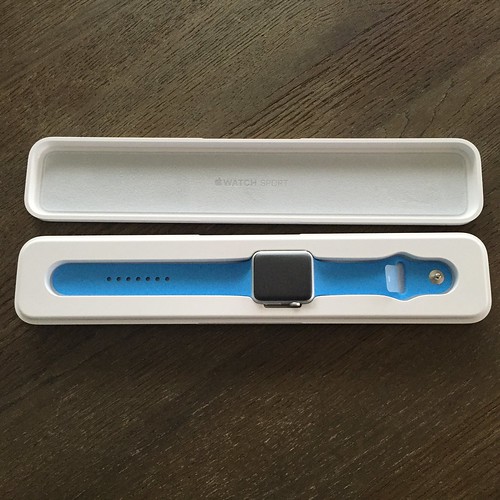
My Apple Watch arrived

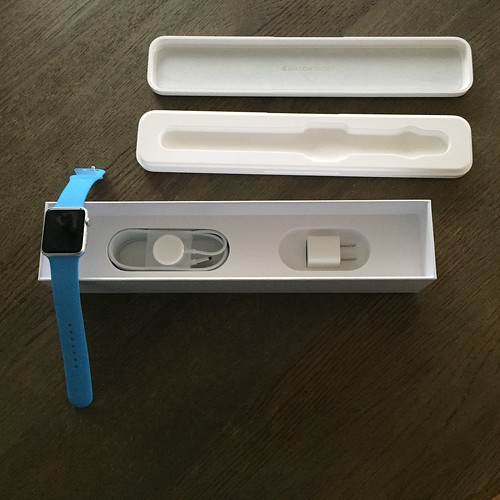
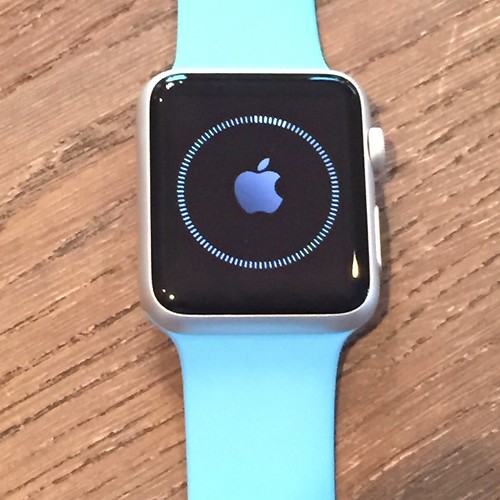
My initial impression upon opening the Apple watch box was that the watch looked okay, but that it was nothing special. Before I could use it I first had to install the latest iOS on my phone (I hate that) and then I had to sync my phone with my watch. Syncing took quite some time, but finally about 30 minutes after opening the Apple Watch package I could start using the phone.

As usual I don’t read manuals but try to figure out how the watch works myself. With just a crown and one other button that should be easy, right? Wrong… If you start using the Apple Watch better view some of the short videos on the Apple site first, that will save you a lot of time and frustration. I figured out most of the things eventually, but it was painful. Unintentionally, I almost called my parents in Holland in the middle of the night because their home number is stored under favorites (the menu where you get to when you press the 2nd button), but luckily I could stop it before it would have woken them up at 3:30 AM…

My Apple Watch arrived

My opinion after 2 days: it’s a fun watch that can do a lot, but it won’t replace my other watches any time soon. It very much feels like a first generation device, there are just so many things that need to be improved. It’s like going from an iPhone 6 to a first generation iPhone but with a much smaller screen.

I figured out quickly that the watch can’t do much without your phone. If you turn off your phone or your phone is too far from the watch most apps won’t run. You can still see the time and you can change all the settings, but that’s about it. I want to use it for running, so I hope it has a built-in GPS because I don’t want to bring my phone on all my runs as well (I didn’t check this yet, but after I turned off my phone just now the maps function didn’t work anymore, so I have my doubts).

I try to like the watch, but there are just too many things that don’t feel right. The screen turns itself off way too quickly, and I have not figured out how to change this (probably you need to do this on your phone, the settings menu on the watch does not seem to allow you to change this). Luckily the watch does not ask you for your passcode each time the screen is off, at least as long as you wear the watch. Tip: if you play around with your watch, wear it while you do so, otherwise you’ll keep on putting your passcode in.

Apple Watch

The watch is also very slow, especially when you compare it to an  iPhone. It’s like being used to broadband Internet and then being forced to go back to dial-up. Maybe this is because the apps are not optimized for the watch yet, but if this doesn’t improve I won’t use a lot of apps on my watch.

For example, my favorite chat & communications app is WeChat. Just launching it takes ages. Going from the home screen to moments (the WeChat ‘timeline’) took exactly 15 seconds just now. That’s just not acceptable in 2015 and I can’t believe Apple accepts this.

On Saturday I tried to pay for my coffee with the Starbucks app on my phone, but after waiting for 20 seconds to load the app I got my phone out and just paid with the Starbucks app on my phone. I was almost embarrassed, because there was a line of people waiting behind me. Later I figured out that the current Starbucks watch app may not even let you pay yet (I could not find how to do it after it loaded). Very strange.

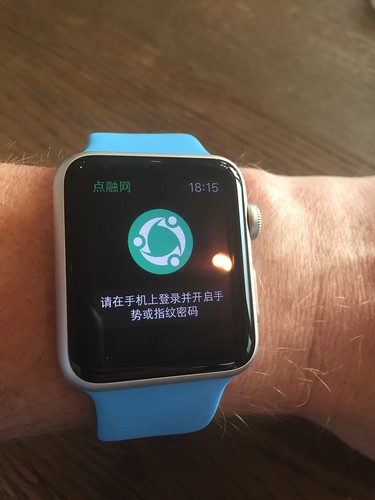
Dianrong.com app on my Apple Watch

Also standard Apple apps like the weather app are slow. Not as slow as some external apps, but to load the local weather forecast takes 3-4 seconds. We’re probably all spoiled, but when you’re Apple and offer premium products at premium prices the user experience should be premium as well.

I don’t dislike the watch, but I have my doubts whether I’ll use it a lot. It just doesn’t look as good as my other watches and the usability is not as good as expected. If you get constant updates on Facebook, Twitter and Instagram you should make sure to turn off notifications, otherwise the constant pings and vibration will drive you nuts. But on the other hand, what’s the added value if you don’t get notified, you might as well get your phone out every 10 minutes or so to check on the latest updates.

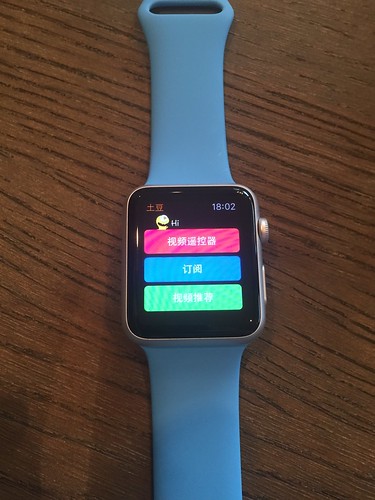
Tudou app on my Apple Watch

What I like about the watch is that the battery life is not as bad as I had expected. After wearing the watch for at least 13 hours today I still have over 50% of battery power remaining. So at least it’s unlikely that I would need to recharge it during the day, as I often have to do with my iPhone. But then again, I didn’t watch any videos on my watch, I only made one or two phone calls on the watch and I didn’t play any games, so maybe the battery will drain a lot quicker if I start using it differently.

I also like that it’s at least partially waterproof. I went for a swim tonight while wearing the watch, and only while swimming I realized the watch may not be waterproof (you also don’t jump in the pool with your phone). But while swimming I immediately checked it and it worked fine – and it still works fine a few hours later.

For me the watch is not more than an extension of my phone. Most calculations are done on the phone, the watch only has 8GB of storage, and many watch apps just tell you to go to your phone to see or read more. I was aware of this, but you don’t really realize it until you start using the phone. It’s a pity, but I am sure in future generations of the watch Apple will solve this, giving us all reasons to buy every single update of the watch. I’ll wear the watch for a few more days, but I’ll likely switch back to my normal watches again after that. My verdict so far: 6 points out of 10.

The state of the P2P marketplace lending industry

New York, view from hotel

I just got back from a week in New York City for meetings with the Uvamo team and for the Lendit 2015 conference. Lendit is a conference focused on the P2P lending industry (nowadays called marketplace lending), and this was the third year the conference was organized.

I had been to the inaugural conference in NYC 2 years ago, at a time when marketplace lending was still something that was relatively small and unknown. I had been investing in LendingClub loans for quite some time already by then, but most traditional bankers I met during that time told me that it was impossible to make consist good returns on a loan portfolio (I was, and am, making a net return of about 8.5% per year). It’s always when things are new that people don’t understand it or don’t want to understand it, so I didn’t argue too much – but I did blog about it a couple of times.

During the first conference the organizers had expected about 200 participants, but the final tally was 375 people. I thought that was quite a lot, but the year after the Lendit Conference in San Francisco had almost 1000 particpants. Suddenly it had become a big event, although marketplace lending was still not mainstream.

But the successful LendingClub IPO in December last year changed things significantly. Suddenly the skeptics realized that marketplace lending is here to stay and that it’s a real alternative to borrowing from banks. I had expected about 1500 people at this conference, but when we had dinner with the organizer the night before the conference he told us almost 2400 people signed up and they had to close the registration.

The conference itself was great. Because I am on the board of Chinese marketplace lender Dianrong.com I follow the space closely and I got to know quite a few people in the industry over the past 2 years. The industry has matured a lot obviously and the start-ups from 2 years ago are now big companies. LendingClub is a $8 billion dollar company and competitor Prosper just closed a private round at a $1.9 billion valuation. They are not banks yet, but they may one day become something like a bank is now.

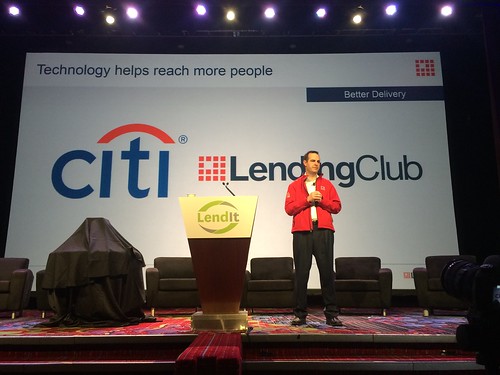
Lendit 2015 New York City

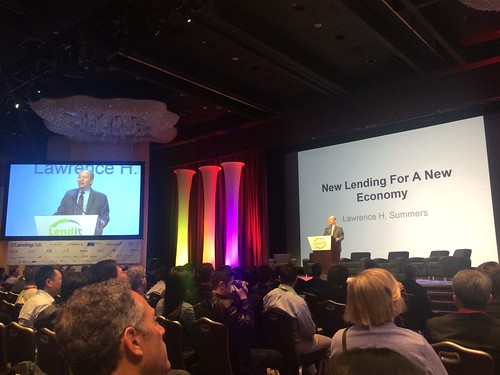
Banks now even want to partner with marketplace lenders. LendingClub CEO Renaud Laplanche for example announced on stage that they started a $150 million cooperation with Citi. Two years ago this would have been unimaginable. And Larry Summers (who is even on the board of LendingClub!) explained in his keynote that the future of finance consists of online marketplaces. He believes that 10 years from now 40-50% of all current bank lending will go through online marketplaces. That means that there is still a huge upside.

Larry Summer's speech

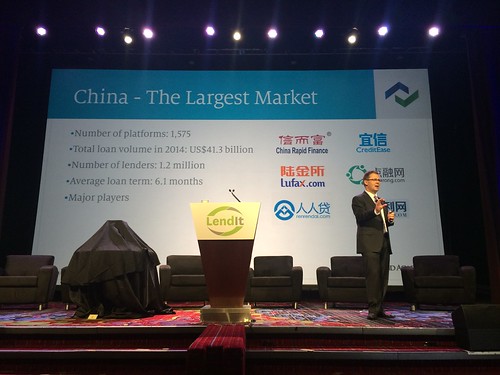
As part of the Lendit conference there was a special China track and there were a lot of Chinese participants. It was probably a good wake up call for many people in North-America to see that US market leader LendingClub is much smaller than some of the top Chinese players. In China the market is booming, it’s incredible. I mentioned this already in another blog post last week where I talked about Dianrong, but growth rates that people in the US can only dream of are normal in China.

Lendit 2015 New York City

China’s P2P market is many times bigger than the US market, it’s even bigger than all other P2P markets outside China combined. Hard to believe? When I see the monthly Dianrong figures I believe it, I have seen the company grow from its first loan 2 years ago until where it is now, that is simply not possible outside China.

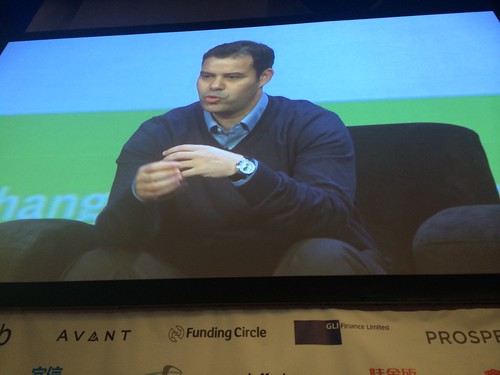
Soul Htite at Lendit USA 2015

One big difference with the US is that Chinese P2P lending companies not just do loans, but they build whole new product categories around it. For example Dianrong, also has a fast growing banking solutions division, that works with some large banks to help them with their technology. Many Chinese lending companies also have a wealth management division, something you don’t see in the US. As Dianrong CEO Soul Htite explained on the main stage at the conference, this is a normal thing for Chinese companies, not just in the P2P lending space. One reason is that you start from scratch in China, there are not many existing tools that you can integrate. E.g. when Alibaba started they had to figure out logistics and payments themselves, Amazon could use existing services for that.

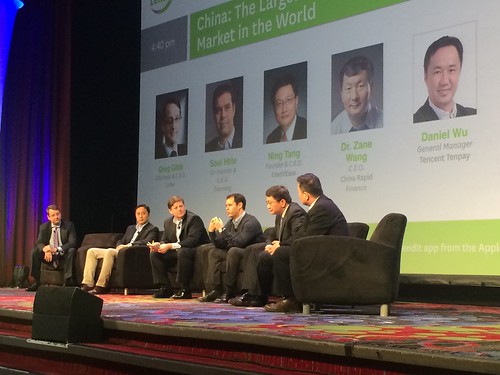
Soul Htite in the China panel at Lendit USA 2015

The extreme competition is another reason that Chinese companies have to innovate faster than their US counterparts. Competition in the US certainly has increased, and CEOs of the leading companies don’t freely exchange information anymore (during a CEO dinner on Monday night the CEOs of Prosper and On Deck did not even mention their partnership to the other participants, even though it was announced pre-market the next morning!). This reminds me of my time in China when I learned the hard way that Chinese companies would not even consider sharing any information with the competition.

I sometimes wonder what would happen if Chinese marketplace lending companies would become active in the US. It’s not happening yet, but I think they could make life very difficult for the leading players. For now they have no real reason yet to move overseas, the opportunity in China is still huge. In China loans are not a replacement for bank loans, but many people or SMEs have no other source to get credit capital. There is still a huge untapped market there, especially now that a large portion of lending and investing in China is now happening on mobile devices.

What’s next? There is a lot of innovation in the financial marketplaces and many niches have been covered over the past 2 years (e.g. student loans, real estate, car loans). But many are relatively small opportunities because they are niche. I think some of the leading players will start acquiring niche players and I think a lot more will go public soon. I think they may turn out to be good long term investments, although they have to show consistent high growth for years to come in order to live up to their multiples. I see more internationalization, meaning US companies moving overseas, or non-US companies expanding to the US. This is already happening, but at a small scale. As for Chinese companies, I don’t see them expanding to the US soon, but don’t be surprised if they suddenly turn up in other Asian countries that are closer to their home base. Exciting times!

Job opening: 2 analyst positions at CrossPacific Capital in Vancouver

View from the CrossPacific Capital office in VancouverView from the CrossPacific Capital office

Our fund CrossPacific Capital (www.xpcp.ca) in Vancouver is expanding rapidly and we are now looking to hire 2 analysts for our Vancouver office. You will work directly with the managing partners, Frank Christiaens and myself.

We are different from other venture capital funds in that we work closely with Chinese strategic investors, limited partners and VC funds, and that we are mainly looking for exits for our portfolio companies in Asia (especially in China). Therefore it’s a prerequisite for candidates to have lived and worked in Asia for at least 3 years. Because there is a lot of communication with China, our analysts have to be fluent in Mandarin Chinese (spoken and written).

You will need to be able to work independently and be able to determine your own work priorities. If you can handle it you’ll get a lot of responsibility (we’ll coach you of course), more than at this level in most other VC firms.

CrossPacific Capital (XPCP.ca) Christmas party 2014CrossPacific Capital office in Vancouver

If you plan to make the switch to venture capital this may be the right job to get into the industry. You will join pitches by companies, do due diligence on them and help us in the valuation and decision making process. We are a small organization, so there are no layers between you and the managing partners, meaning that you have a lot of direct exposure to what happens in and around the firm.  Frank and I tend to be quite direct (we’re both originally Dutch…), but you’ll probably get used to that quickly. Occasional travel may be required, depending on projects and clients that you work with.

Our office is in the the middle of Gastown in Vancouver, surrounded by bars and restaurants, on the top floor of a heritage building with great views over Vancouver harbour and the North shore mountains. Several of our portfolio companies are in our office, and because of our open office environment you’ll have a lot of contact with them.

Our analyst Ms. Bing Dai, who plans to do a start-up as the next step in her career, said on her Facebook about her current job: “I learned more about entrepreneurship, technology and human interactions during the past two years at CrossPacific than any period before. A great environment to hang out with amazing people around the world and experience what starting/investing in tech companies is actually like.” Hope you don’t mind me copy/pasting your text Bing 🙂

The official job ad as posted on our website:

Company

  • CrossPacific is an asset management and advisory firm, strategically headquartered in Vancouver, BC Canada, North America’s Gateway to Asia.
  • CrossPacific invests in Canadian and select US technology companies and creates value through cross-border business expansion into China. CrossPacific also invests in companies that would be investment targets for Chinese companies looking to expand their presence in North America.
  • CrossPacific is managed by 2 Managing Partners and 1 CFO. The team is strenghtened by 2 Venture Partners, Enterepreneurs-in-Residence, and Advisors.


Responsibilities

  • Market Research
  • Financial Analysis
  • Due Diligence Support
  • Business Developmemt Support


Required Expertise

  • Having worked in Asia for a minimum of 3 years
  • Strong analytical and quantitative skills
  • Excellent Excel skills
  • Eager interest in technology
  • Deep knowledge of certain technologies
  • Prior start-up experience a plus – not a requirement


Education Level

  • University level Master degree from recognized university, preferably with an undergraduate degree in engineering or science
  • Native Mandarin
  • Fluent English
  • Other languages a plus


Compensation & Perks

  • Base salary negotiable
  • Bonus as a function of value created for the Fund
  • MSP
  • Medical and dental insurance
  • Awesome Gastown office with waterfront views, accessible by Canada Line, Expo Line, Millenium Line, and many downtown buses


CONTACT: Ms Rui Habib, rui@xpcp.ca

A Few Days In China: Some Thoughts And Observations (Part 2)

XintiandiShanghai, view over Xintiandi

After some impressions about life in general in my post yesterday, today some more business related topics that I noticed during my trip to China last week.

Valuations
Company valuations are going through the roof, especially private company valuations. When Tudou raised its first round in late 2005 valuations were probably 10% of what they are now. At one time Tudou raised the largest round ever for a Chinese company, which was $57 million at that time. Now that number is just peanuts and many companies have raised hundreds of millions in later stage rounds.

Although in Silicon Valley valuations are also extremely high (e.g. Uber @ $40 billion and Snapchat @ $19 billion), I have the feeling that Chinese tech companies tend to get ever higher valuations based on the same numbers. I have no data on this, but that’s just what I hear when talking to local VCs. One reason may be that the Chinese market is potentially much bigger than the US market, although most Chinese have a lot less earning power. And for Chinese companies it may be easier to go abroad (with the right management teams) than it is for US companies to enter China.

Buying R&D
A relatively new trend is that Chinese companies are now actively buying R&D from outside China. With growth rates going down to about 7% this year they need to find other ways to grow faster, and foreign intellectual property is a good investment for that. We see it a lot at CrossPacific Capital and several of our portfolio companies are in discussions with Chinese buyers. Chinese companies are especially looking for companies that can deliver revenue right away, so products that can immediately be integrated or sold in China.

The valuation of these companies mainly depends on the current product portfolio and less on the value of the IP for future products. Chinese business men want to see results now, nobody knows what will happen in 4-5 years so that’s less important. Generally valuations for these companies are a lot higher in China than in North America, meaning that if you can identify the right products or technology you can make a good return on your investment. However, valuations are not as high as Chinese Internet and tech companies.

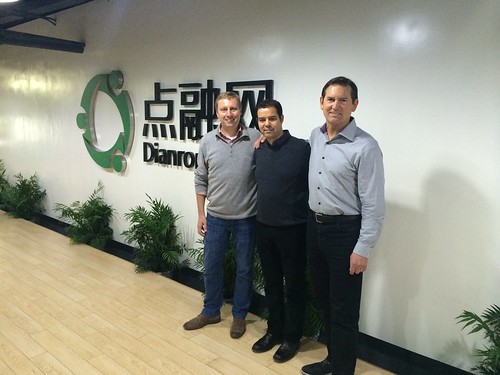
Marc, Soul & Scott at the Dianrong officeMarc, Soul and Scott at Dianrong’s Shanghai HQ

Dianrong
One important reason why I was in China was for a Dianrong board of directors meeting. Dianrong is a Shanghai-based P2P lending company, comparable to LendingClub or Prosper, but only focused on China (for now) and therefore with Chinese characteristics (shorter loan duration, higher interest rate etc.). The company is also active in banking solutions for traditional banks.

When I first met Soul Htite, the founder and CEO of Dianrong, a few months before I left China in 2013 he was so convincing about his plans that I fairly quickly decided to invest. That was a good decision because Dianrong turned out to be one of the fastest growing companies I have ever been involved in. It’s unbelievable how innovative the company is and how it manages to handle its growth. The company is obviously still privately held, so I am not able to share any data here, but trust me that the figures are extremely impressive.

In my opinion, one major strength Dianrong has is the management team that Soul put together. Many of the executives are graduates of top US schools like Harvard, MIT, Stanford or Wharton, or from Chinese top universities (or both). The team understands both the Western and the Chinese financial and Internet world and that makes them stand out from many of the other Chinese P2P lending companies.

Dianrong is the type of company that could conquer the world from China. Not just South-east Asia like some ‘traditional’ Chinese Internet companies are doing already, but possibly also the Western world. Yes, I am biased of course, but keep an eye out for them!

WeChat
While many people in North-America have never heard of it, WeChat (微信) is now the only app you need to do business in China. Originally a messenger app comparable to WhatsApp, it has grown into a mobile-first combination of the Facebook timeline (with built-in privacy!), Messenger, Skype, a business sales & marketing platform, and a group communication tool like Slack. Companies like Dianrong rely on WeChat for communication, and in many instances it has replaced email. You can run a company on WeChat these days.

I use WeChat a lot in Canada as well, but it’s not really taking off yet among people that don’t have a lot of connections with China. I hope that will happen though, because it’s extremely useful and a great way to stay connected to people that you meet. Next to exchanging business cards you now just scan each others QR codes to get connected. If you want to do business in China make sure you have WeChat installed on your phone.

The future of retail
If you want to understand how retail in the West will change, come to China first. Already a couple of years ago people were ordering everything online and that has only increased. Real time delivery for (almost) free is the norm and I believe that China might be the first country where large supermarkets and other stores may disappear. There are still a lot of shopping malls, but if this trend continuous they will be mainly for high-end brands (where the retail experience is important) or just for window shopping.

It’s hard to imagine how fast online retail has grown. In March 2013 when I left China McKinsey estimated that by 2020 Chinese online retail would be between $420-$650 billion. Guess what, in 2014, so just one year later, online retail was already at $450 billion in China. I don’t want to criticize McKinsey too much, but they clearly should do their homework a bit better and learn about exponential instead of linear growth (their models worked with 15-20% growth per year and were likely based on 2011-2012 data, but real growth in 2013-2014 was over 50% per year).

The fast growth is partly because of convenience, because urban Chinese work longer hours than people in Europe or the US and therefore have less free time for shopping, but also because of traffic jams, lower car ownership and pollution. If you know it will take you a long time get to a large supermarket, you don’t have a car or if it’s very smoggy outside you might as well order everything online. And don’t forget the secondary and tertiary cities where people also have a lot more disposable income nowadays, but where lots of products are not for sale in offline stores.

The next big business opportunity: Senior care
If you want to catch the next big wave in China (outside of tech), look at opportunities in senior care. There are many reasons why this is such a huge growth market and I could probably write a complete blog post about it, but I’ll just list the main ones here:
– Most Chinese below 40 don’t have brothers or sister because of the one child policy. Traditionally Chinese take care of their parents, but if 2 people have to take care of their aging parents next to their jobs and kid(s) that can be a major burden.
– Urban Chinese don’t have large apartments, so taking care of their parents is not always possible
– Younger Chinese are more affluent and can (and are willing to) pay for senior care
– Sending your parents to a senior home is not a taboo anymore
– It’s difficult to find good senior homes, at some of them wait lists can be decades

My friend Ninie Wang saw this opportunity already back in 2003, right after graduating from INSEAD. She was one of the very first but the sector is now growing fast, but there are still a huge opportunities for anything related to Chinese senior care.

A few days in China: some thoughts and observations (part 1)

Shanghai by night

Shanghai by night

Last week I spent a couple of days in Shanghai and Beijing for among others a Dianrong board meeting, for meetings with other VCs and investors, and of course to catch up with friends. It was a busy week where I did not sleep a lot, but a trip that was totally worth my time.

I am now back in Vancouver and my mind is so full of thoughts and observations about the trip that I decided to put some of them on virtual paper and post them on my blog. We have now been away from China for over 2 years and that gives me some much needed distance to see the country in a more objective way than when we were living here or when we had just left. I will put my thoughts online in 2 separate blog posts, because there is way too much information for just one article. The first one is more about life in general, the second one will be more about business and investment related topics.

Pollution
The bad air was probably the main reason why we left China. I got sick (literally!) of not being able to run outside and I felt really bad for the kids when they could not play outside most of the time. Waking up to a grey world in the morning while the sun was supposed to shine made me feel angry while living in Shanghai. But interestingly, during this trip it did not bother me as much. Why? I guess because it’s just for 5-6 days and after that I would be back in the clean Vancouver air. Although I started to cough again and felt my throat while running, I just shrugged it off.

Smog at the approach to Pudong airport


Smog during approach to Shanghai Pudong airport

The smog was not too bad as well, most of the time between 150-200 PM2.5 (which is merely unhealthy, although in Vancouver probably nobody would be allowed to go outside anymore at these levels), which means that it was normallyhazy but that you could easily see a few hundred meters. I couldn’t run outside though, which was a bit of a nuisance, especially during my early morning 25 km run on Sunday. Generally I did not feel that the pollution was much worse than 2 years ago, but this was just a 6 day sample – and the day before I arrived Beijing had a hazardous 800+ pollution reading – so this is in no way a scientific observation.

Taxis
While living in China I had a car and a driver, so I did not use taxis much. However, when I needed them I could normally easily hail one on the street. That has changed quite a bit in 2 years because of taxi apps. If you don’t have these installed it’s very hard to find a taxi, even outside of rush hour. The reason is that the taxi apps subsidize their drivers, they get a few extra RMB on top of the taxi fare to lure them to work with the taxi app company. The downside is that they are not very interested in picking up passengers on the street or at hotels anymore.

The problem for most non-Chinese is that the taxi apps are in Chinese, so they are difficult to navigate. Uber works in China as well (it’s called People’s Uber here), but it’s not as good as in the US. The drivers seems to be new and often have no clue about directions, but at least many of them speak some English (that hardly ever happens with normal cab drivers). I tried to add my Chinese phone number to the regular Uber app but could not input the verification code, so the app was suddenly useless.

The few normal cabs that I used suddenly relied on their taxi app GPS system to get to the destination, instead of just thinking themselves about how to drive there. In the past drivers often had no clue about where to go and I had to guide them, but now they first take minutes to input the address, then they follow the directions exactly (instead of thinking about taking a faster side street like in the past) and one still drove past my destination (I had to point it out to him). One small difference is that many now seem to accept tips, so I could round up to the next 10 RMB and didn’t get tons of coins or bills back.

Internet
My biggest headache in China was the slow and censored Internet, it drove me totally nuts at times. In Canada I am so used to using my smartphone for everything, it’s like my second memory. But in China that second memory was suddenly extremely slow or did not work at all. I did have a VPN but it did not always work or it got blocked for a while after visiting ‘harmful’ sites like Google.com. Even with VPN I could not load Facebook on my laptop, although I managed to get an occasional connection on my mobile phone. Most of my business is done through a Gmail account, but half of the time I could not access it, not even with my VPN running.

The non-Chinese Internet seems to be much slower and stricter than 2 years ago. This was my biggest frustration during the trip, much bigger than the traffic or the pollution. If I should ever try to live in China again this should be solved first, I guess I am too spoiled after using normal Internet in Vancouver. Maybe a better VPN and a faster mobile Internet connection may help, not sure.

Cultural changes
I feel China, especially Shanghai, has become a lot more Western over the past 2 years. Shanghai was already the most Westernized city, but the way people dress and behave in places like Xintiandi is virtually the same as in higher end places in North-America. While having breakfast in Xintiandi on the weekend I noted several fathers with their young sons having (Western) breakfasts as well, just like I would with my son Scott. There are a lot more outside terraces (esp. on the street outside Xintiandi Style) where people are having coffees while chatting with friends, much more than before I left.

The number of high-end shopping malls seems to continue to go up, despite the fact that many are quite empty. I suppose brands need to be visible, so people know what to buy during their trips outside China. The shopping malls are world class, better than anything you find in North America, and comparable to Tokyo, Hong Kong and Singapore. I don’t like shopping at all, but I did not mind strolling around some of the malls looking at the high-end products for sale.

People keep on dressing better as well. Especially in the business districts of cities like Shanghai or Beijing people seem to dress better than in the US or Europe. Less casual and with higher quality clothes than just a few years ago. I dress quite casual myself (high end jeans, dress shirt & jacket) and found myself underdressed on at least 2 occasions…

View from the Park Hyatt on a clear spring day


Traffic at the Guomao intersection of the 3rd ring road, there are traffic jams all day.

Traffic
Not much change, although it seems to be even more busy now than it was when I left. It’s virtually impossible to do more than 2-3 meetings a day in Beijing, unless they are in the same area or unless you are willing to take the metro. People still drive like they did before, not caring for others and using the horn constantly. On the first day I almost got hit by a car while on a zebra crossing with a green pedestian light. I guess I have become too North-American and forgot that that does not give you any additional rights as a pedestrian.

What I noticed that cars seem to be much nicer than before. There are not many old cars on the streets of Beijing and Shanghai anymore, likely because of the license plate taxes and because of environmental requirements. The number of super high-end cars is not as high as in Vancouver yet, but seeing a Lamborghini, a Ferrari or a Bentley is quite common.

Hotels
The top hotels in Shanghai and Beijing are so much better than in North-America, it’s almost incomparable. In Shanghai I stayed at the Langham in Xintiandi and in Beijing at the Park Hyatt close to Guomao, and both hotels were amazing. The service is impeccable and very fast, and staff has been trained well (often a problem in Chinese hotels and restaurants). The rooms are very well designed and much nicer than for example those of Langham hotels where I recently stayed in North America (in Pasadena and in Manhattan). Especially the Park Hyatt room was beautiful and very modern, with a huge bath tub (that I didn’t use) and sliding doors to divide the room into a bedroom and a bathroom. Small things like a power plug in the safe to recharge your gadgets, or boutique toiletries and high-end linen on the beds make the difference between a good hotel and a great hotel. The only bad thing was the slow Internet in both hotels, but I guess that’s not something you can blame the hotel for.

My second blog post with some observations about business in China is here.