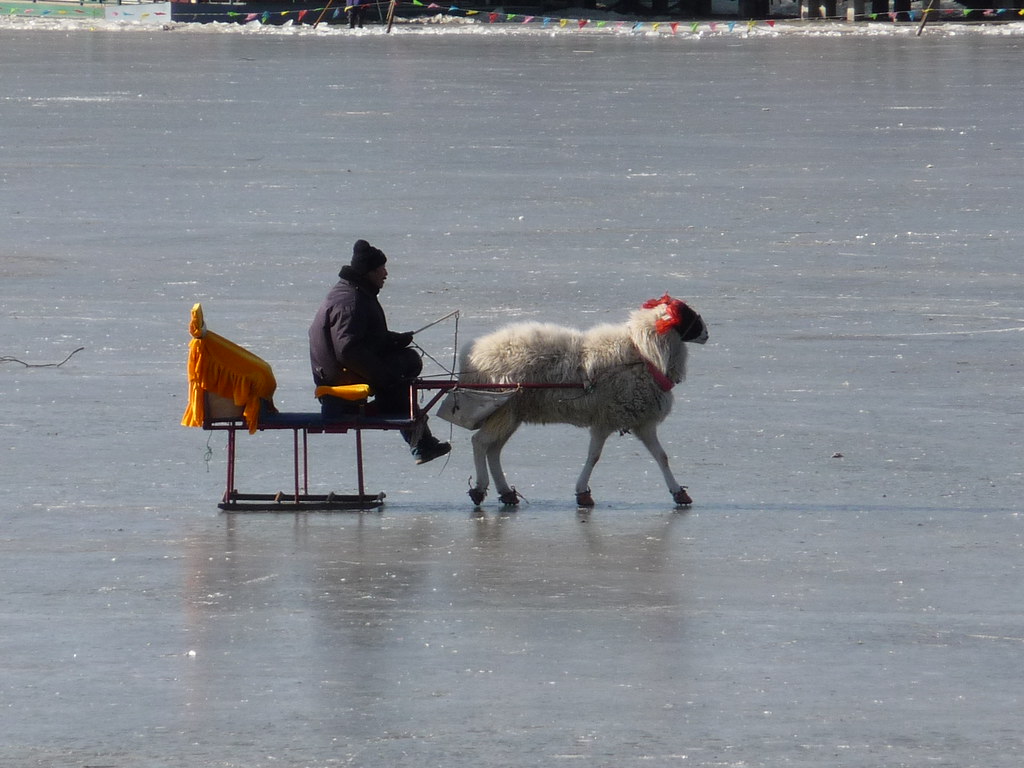
Shanghai – some things don't change over the years

I just started reading “400 million customers” by Carl Crow, a book that was originally published in 1937 but that has now been reprinted by Earnshaw Books. The most striking thing about the book is that so many things have not really changed over the past 70 years and that especially foreign business men keep on making the same mistakes in China.

I like to read books about China’s history, especially about the past 100 years or so, but I like film footage even more. So I was quite happy to find a link to a film about Shanghai in 1947 on Danwei today. It’s a still movie, but in between the scenes it gives some comments about what you see in the film.

Also here I notice a lot of similarities between Shanghai 60 years ago and now. Traffic is just as chaotic as it is now, and not only on the streets but also on the water. Go with the flow was also then the best way to get to your destination without getting into accidents. Fake products are not new to China, Carl Crow describes that both Chinese and Japanese factories immediately copy new products. And this can be seen as well in the film, where there is footage of a ‘black market’. The only difference is that fake markets are now mainly frequented by foreign tourists.

Another thing that struck me is that China did not seem to have high value money bills, just like now. In the film someone is selling (or pawning) gold and gets a large stack of money in return. Nowadays China’s largest bill is just RMB 100 (about EUR 11), and because a lot of transactions are still cash-based you can see people leaving or arriving at banks with bags full of money

Human power is still used to transport products from one part of the city to the other. At least once a week I see migrant workers using ropes to pull carts with wooden poles over the steep bridge close to Tudou. Exactly the same as what you see in the film. One thing I noticed is that there were no horses in Shanghai in 1947, I only see boats, cars and bicycles. Were they not allowed in the city?

If you enjoy this kind of films, then also check out this one about Hong Kong in 1938 (h/t Thomas Crampton). Both films are part of The Travel Film Archive on YouTube that has a lot more historical travel footage from all over the world.

What Would Google Do?

A few weeks ago I got my hands on a pre-galley copy of Jeff Jarvis upcoming book What Would Google Do? Judging from the title you might think this is just another book about Google, but it isn’t. It’s a book about seeing the world as Google sees it. What Jarvis did is translating Google’s way of doing business into a set of rules to live and do business by.

I loved the book, not only because it’s a highly entertaining read filled with real life examples, but especially because I think it will open the eyes of many people about how the world has changed because of the Internet, and what they should do to stay ahead or at least keep up. Many of the Google Rules that Jarvis defines are very recognizable to me and several have helped me to grow my businesses over the past years. But others I did not really think through yet, so they were quite thought provoking while reading the book.

The first part of the book is about the Google Rules, the way Google does its business, about 30 in total. Some of the most important include:

– Jeff Jarvis First Law: Give the people trust and we will use it. Don’t and you will lose it. The powerful (companies, institutions and governments) used to be in charge because of the control they had, but the world has changed. They can only win it back by being more transparent and listen to their customers

Your customer is your advertising agency: Google spends next to nothing in advertising, people spread the word for them. Let your customers do that for you. Good news for Internet Word of Mouth companies like Sam Flemming‘s CIC (in which I am an investor).

Join the Open Source, Gift Economy: Your customers will help you if you ask them, people like to be generous (look at Wikipedia for example)

The masses are dead, long live the niches: Aggregation of the long tail replaces the mass. Not one online video will have the ratings of the Superbowl, but together they capture a huge audience

Free is a business model: Google will find ways to make money by offering services for free. Charging money costs money

Make mistakes well: It can be a good thing to make mistakes, but it depends on how you handle them. Corrections enhance credibility. You don’t need to launch the perfect product, your customers can (and will) help you to improve it

Beware of the cash cow in the coal mine: Cash flow can blind you to the strategic necessity of change, tough decisions and innovations

These rules will change the way you will do business. And not just for obvious industries like the Internet or traditional media. In the second part of the book, If Google Ruled The World, Jarvis describes the impact on (or better: opportunities for) many different industries. From media to advertising, from retail to manufacturing, and from the service industry to banking and VC’s. He describes how these industries will be forced to change and how you can become a winner by changing faster than your competition – or lose everything if you believe that your current business model will survive. A thought provoking and very inspiring part of his book. If you’re in one of the industries mentioned above it is a must to read his analysis. Even if you are not convinced by Jarvis analysis, it should make you think about the opportunities and threats the future holds for you.

The final part of the book, Generation G, is more about the impact of Google on personal life. Google will keep people connected: young people will stay linked, likely for the rest of their lives. This improves the nature of friendships and how you treat each other. Past mistakes will be visible forever, but if you made mistakes it not a big issue, because everybody did. An age of transparency must be an age of forgiveness, in Googlespeak: Life is a beta. Privacy is not the issue, but control over your private information is.

A lot of people my age (I’m 36 years old) ask me why I put my whole life online, they do not understand this. This book may help them to understand. And it’s not just me doing this of course, it’s the whole younger generation doing this. Sharing of information is a social act, it is the basis of connections. Sharing brings social benefits that outweigh risks. Withholding information from the collective knowledge may even be considered anti-social. If I look at Twitter and read what other people are for example eating for breakfast, some people may laugh and say it is nonsense to put that online. But Jeff Jarvis calls it ‘ambient intimacy’ and explains that it is good for friendships.

It does not happen often that I read a book that I fully agree with, but this is one of them. Mr. Jarvis puts on paper how I see the world changing around us and how I see people getting left behind because they fail to see it. But he also explains what they can do to keep up or stay ahead of the rest. For people living and working on the Internet like me, a lot of things may not be new, but reading Mr. Jarvis analysis is still very worthwhile. If you do not know all ins and outs of the Internet, this book is a must-read. If there is one non-fiction book you plan to read this year, this should be the one.

What Would Google Do? will be published on January 27, 2009. You can pre-order it here.

Spil Games Asia launches Chinese web game channel


What’s the best way to avoid the consequences of a possible recession? Keep on innovating your products and improving your services. So that’s what we have been doing at Spil Games Asia over the past months. One result of this was launched this week: our Chinese web game channel at ol.game.com.cn

Webgames are massive multiplayer online games that you do not need to download, but that you can play directly in a web browser. That means that you can immediately start playing the game on every computer with an internet connection. No download and installation needed!

Our web game channel launches with one game, ???? (Wang Ye San Guo), a cute-looking Three Kingdoms game. The game is free-to-play, with a business model based on virtual items. We have two more games lined up that will launch shortly, and a couple more will follow later this year.

M1NT restaurant also open to non-members


If you have followed me on Twitter you’ll have noticed that I already had a couple of excellent lunches and dinners at M1NT Shanghai over the past weeks. The club’s restaurant is located on the penthouse floor of the Cross Tower, giving diners a spectacular view the city and the Pudong skyline.

What many people may not know is that the restaurant is also open to non-members, so if you are looking for a special place for lunch or dinner keep this place in mind. M1NT now also has a special tasting menu for RMB 388 per person, including a glass of champagne and club access afterward. Recommended!

Bookings: bookings@m1nt.com.cn or call +86 21 6391 2811
24/F, 318 Fuzhou Road, Shanghai (corner of Shandong Road)

Annoying LCD advertising in Shanghai – but not long anymore!

Picture: Qifei 2.0 www.flickr.com/photos/qifei_20/2257829658/ (creative commons)

Wherever you are in China you know you will get bombarded with advertising, but sometimes it gets a bit too much. The Bund in Shanghai, the waterfront on the Puxi site of town, is a good example of this. Just a few years ago it was a nice location to take some pictures of the Pudong skyline. But about 3 years ago two of the skyscrapers (first the Aurora tower and later the CitiBank tower) have both been converted in huge LCD screens. I hated it at first, but somehow I have gotten used to it – I could see them in the distance from my former apartment and after a while you sort of blank them out in your mind.

But what you cannot ignore are the LCD screen ships that started cruising along the Bund in 2006. It is an extreme case of horizon pollution: you cannot even see the horizon anymore because a 30 meter long LCD billboard is in between you and the scenic other side of the river. I vowed never to use a product or brand advertised on them, but too many brands are using this “new marketing opportunity” nowadays, so it’s become almost impossible.

When you can put a LCD screen on a boat you can of course also put one behind a car, and that’s what some entrepreneurs are doing now as well. I wonder if these mobile LCD screens have caused any accidents so far. Or maybe drivers are so used to all advertising around them that they do not even notice them anymore? That happens me to me in taxi’s in Shanghai, where most have an LCD screen built into the front passenger seat, so you can happily watch commercials while being driven to your destination. I hardly notice the screen anymore. And if I do I turn off the sound and put a coat over it – problem solved.

But if you think LCD screens on buildings, cars and boats cannot be topped, you underestimate Chinese entrepreneurial creativity. A few days ago I was having a drink at the 24th floor bar at M1NT when I suddenly saw an LCD screen right in front of me outside the window. It took me a few seconds to figure out what it was, and then I realized it was a zeppellin with an LCD screen on it. I tried to take a picture, but the combination of taking a photo with an iPhone from a lighted bar while it’s pitch dark outside leads to sub-optimal results (and that’s a big understatement). Hopefully you can just make out the zeppelin in the middle of the picture, just to the right of the Oriental Pearl Tower.

Coincidentally, while writing this during my lunch break I took a glance at today’s Shanghai Daily and what headline do I see? “City to curb those ads on the move”. The city government has drawn up a series of regulation to restrict outdoor advertising on moving platforms, and these should be approved this month. That means that the ads on the skyscrapers may not go away, but the boats and aircraft will be a thing of the past very soon.

The boats “could affect cargo and passenger ships from clearly seeing navigation lights on the river”, according to the paper. For that reason they will not be allowed anymore between the Yangpu and Lupu bridge (which includes the downtown part along the Bund). Not sure why that would not be big issue on other parts of the river, but good to hear!

The environmental watchdog, the government organization in charge of these changes, will also include buses and taxis in their new regulation. Buses, for example, will only be allowed to carry advertising on a reduced space on their exterior. But because the environmental watchdog is not in charge of ads inside buses and taxis we will still have to endure the LCD screens inside the taxis.

Slumdog Millionaire


I am in a review mood these days, probably because work has not resumed at full speed yet – even though today was a regular working day and I spent the whole day in the office. Last night I walked by one of the DVD shops on Hongmei Lu and noticed that they had Slumdog Millionaire. I read quite a lot about it on Twitter already, so I decided to buy it and watch it right away. It was an excellent choice!

Just like most novels I read, I tend to forget about the movies I watch the next day already. Only a few really good ones stay with me for a long time (Ray for example, or The Thomas Crown Affair are films that come to mind right away). Slumdog Millionaire might be added to that list as well.

If you have not heard about the movie, for example if you live in Europe where the movie has not yet been released in most countries (in Holland for example the first screening will be on February 12 and in Germany only on March 19), I am sure you will hear about it soon. This might be Oscar material, and the movie has already been nominated for 4 Golden Globes.

Slumdog Millionaire, based on the novel Q&A by Vikas Swarup, paints a lively but painful picture of survival in Mumbai, a city full of danger and violence. It gives a fascinating look into life in the underbelly of India, which is not a pretty sight. Jamal, an young orphan from the slums of Mumbai, his brother Salim and another girl from the slums (Latika) try to make a life for themselves after their mother is killed during an anti-muslim riot. Years later the uneducated Jamal ends up in the quiz show Who Wants To Be A Millionaire? where he manages to answer all the questions correctly, leading to an interrogation by the police because they think he may be cheating. During the interrogation you learn why Jamal could answer all the questions and what happened during his journey from the slums to the hot seat at the popular quiz show.

I won’t give more of the plot away, but it’s a combination of a fast-paced action movie and a romantic film, with a Indian Bollywood twist. A bit of Charles Dickens’ Oliver Twist meets 21st century India. I loved it, not only because I visited Mumbai myself and some places are very recognizable, but for the most part because it’s a “from rags to riches” (or better “from rags to rajah”) feel-good story. And others love it as well, on Rotten Tomatoes the film currently has a 94% rating and IMDB shows an 8.7/10 rating (#46 out of all movies).

As a side note, the movie’s soundtrack is great as well. I just downloaded it and am listening to it while writing this blog post. Enjoy!

See the trailer for the movie here:

My favorite books of 2008

Yesterday I finished a pre-galley version of Jeff Jarvis’ upcoming book What Would Google Do? and I twittered that it was the best book I’d read this year 🙂

But I also said that it would have ended in my top 3 of 2008 had I finished it a few days earlier. Then James Gwertzman asked me on Twitter what my top 3 for 2008 would be. A good question, and I had to narrow down a list of about 10 books, but I finally came up with these three (in random order):
The Black Swan: The Impact of the Highly Improbable – Nassim Nicholas Taleb
God is not Great: How Religion Poisons Everything – Christopher Hitchens
Mao: The Unknown Story – Jung Chang and Jon Halliday

Only non-fiction on 2008’s list, even though most books I read are fiction. Most novels, however, I forget about the day after I finished them. A nice way to relax at the end of the day or on a holiday, but nothing more. But these three books I still think about and discuss regularly with friends. In case you have not read them, below a quick take on why I like them.

The Black Swan is actually the second book by Taleb that I’ve read this year, I should probably also mention Fooled by Randomness here because both books cover the same subject. Mr. Taleb is a financial trader with a very strong mathematical background. His message is very simple, don’t look for patterns in events. The most important events are random and unpredictable, but most people (including traders) do not realize this. When something happens people look for explanations, but not everything can be explained.

Why does someone become a millionaire? Can you repeat what he or she did and also become rich? No, often it is just random factors, so no need to buy books about how to become a millionaire. Observing something once does not mean it will happen again, and even if something happens a few times it still does not mean it will happen again. The book derives it title from the fact that for centuries Europeans had only seen white swans, so it was a scientific truth that all swans are white. Until in 1697 black swans were discovered.

The Black Swan and Fooled by Randomness are the least easy-to-read from the three books on my list, but both books are a must read if you want to understand the world a bit better. Mr. Taleb knows what he talks about and had done his homework before writing this book. The book is full of real life examples, making the theory easier to understand and making it a sometimes even fun read. The global financial crisis and the resulting stock market crash have proven the author right, they are exactly what the author is talking about: unpredictable.

God is not Great I bought last year around Chinese New Year and I was immediately hooked. Mr. Hitchens is known for his controversial ideas and that’s why I like him. You need people like him to stir things up. Watch some of his video’s on YouTube to get an idea of who Mr. Hitchens is. I sort of like him, but he is certainly not somebody who wants to be liked.

In this book Mr. Hitchens convincingly argues that religion is man-made and actually quite dangerous. Religion is based on ancient beliefs, it stems from times where most people were illiterate and tried to explain the world with the little scientific knowledge available to them. I agree with him on that and this book has changed my view on religion.

However, Mr. Hitchens could have made his case stronger by being a bit more tolerant of believers. Religion also has it good sides (it gives people hope for example), he is too much focusing on the problems that religions have caused (and are causing) for this world. By being a bit more open to other opinions and by not only trying to offend believers he could have been even more convincing.

The book is in my top 3 because of the impact it had on me and my thinking about religion. As some of you may know I lived in a fundamental Christian family for a while in the late 80’s in the US, and that experience changed me at that time. Looking back it was one of the best things that could have happened to me, because I have a lot more understanding now for people with different views of the world and how they get these ideas (a lot is based on peers having the same views and wanting to be part of the group). I am not a Christian anymore, however, mainly because I saw how absurd fundamentalism when I was able to look at it from a distance. This book reinforces my ideas, but I am afraid it is close atheist fundamentalism.

The third book, Mao, is also quite fundamental in its views. It is a very one-sided account of who Mao really was. Living in China for many years, I have heard numerous stories about Mao. Some from people who still fully support his ideas and even his ways to reach his political goals. Others from people who are more moderate and follow Deng Xiaoping’s line that Mao was 70% good and 30% bad. And some, but a minority in China, completely denouncing Mao and everything he has done.

This book follows the last view. And just like God is not Great it loses some credibility because of this. It shows Mao as an opportunistic crook, a mass murderer who was only thinking about himself. He was a brilliant politician playing out all his opponents against each other in order to reach his goals. Even though I think it’s a pity that Jung wrote the book from a very one-sided perspective it makes for an extremely interesting read for anybody who wants to know more about what has happened in China during the first three quarters of the 20th century. The book reads like fiction, and it’s sometimes hard to believe that everything really happened. Be prepared for a long read though, the book is over 600 pages plus almost 200 pages of references.

Photo shoot for Scott's 1st birthday

Last week Scott had his first birthday and because of that we decided to take some professional pictures of him. We found a photo studio specialized in baby pictures on Hongmei Lu (Babypark, 5/F, 3211 Hongmei Lu, phone 021-6208 3786, above City Supermarket) and last Sunday we went there to do the photo shoot.


The shoot itself was quite tiring: Scott did not exactly like to follow the photographer’s directions and he had to use many tricks to get Scott to collaborate. It took us over two hours to take all the pictures we wanted to take, but it was totally worth it. We love the photos! The photographer said that Scott actually did quite well, normally one-year old babies are much more difficult to work with. Glad I don’t have his job.


The other pictures you can see here as a set on my Flickr account.