
 I am a big fan of Second Life, but my ‘First Life’ is already too busy to spend much time there. This cartoon comes from bLaugh, The (un)official Comic of the Blogosphere.
(via: Marketingfacts.nl)
Trend: dig your own well
If you live in one of the compounds on the outskirts of Shanghai, this is probably no news to you. Many of the owners of villa’s in suburban Shanghai are digging their own wells to save on water costs. Construction companies only charge RMB 300-RMB 1000 to provide you with your private well, so the money can be earned back relatively quickly. But the result be may less desirable: not only does the ground water level go down, but if too much water is pumped out (not unlikely with 1000’s of people doing this), there may be structural damage to the houses if the land subsides. According to the Shanghai Daily the government is not doing much: the Land Resource Administration Bureau only takes action if an illegal well is reported, it does not send out inspector to do checks.
No more Mercedes taxis?
Most taxi’s in Shanghai are Volkswagen Santana’s, with an occasional Passat thrown in. But since early 2005 Dazhong taxi also introduced light blue Mercedes-Benz E-class taxi’s. They are quite popular, because they are the same price as the old Santana’s. But that low price may mean that soon the Mercedes taxi era will be over in Shanghai. Yesterday the Shanghai Daily already mentioned that there were rumours among taxi drivers that Dazhong taxi would discontinue its Mercedes-Benz taxi fleet. And today they write that this is indeed true: out of 100 MB taxi’s 45 will be discarded soon.
The reason? Mainly the fact that the company is not allowed to charge higher fees for luxury cabs. The operating costs of a Mercedes is of course much higher than a Santana (not only the depreciation, but also gas, repair and spare parts). I would not mind to pay double or triple the price for a decent taxi, but it is just not allowed in China. Therefore many MB taxi drivers refuse to take people on short rides (they earn less on those), and try to get rides to the airport or other cities for fixed prices.
According to the article another reason is that it is quite difficult to get spare parts on time, because they have to be imported from Germany. I wonder if this is really true. I am quite sure many spart parts are on stock at dealers, especially because the E-class is now produced in Beijing as well.
Taxi’s in China normally have anti-robbery plastic boards, roof taxi lights and seat covers. But many customers asked the drivers to take these off, so it looks like they are not using a cab, but their own luxury car! Because drivers are not allowed to do this this often led to disputes and complaints. As all the taxi’s are light blue and there are no other light blue Mercedes E-class cars in Shanghai, it is quite obvious that these customers are riding a taxi. But they seem to forget that in their efforts to gain face by showing off.
So what will happen to these 45 discarded taxi’s? Nobody knows yet. But if you are looking for a well-maintained, but heavily used, second-hand Mercedes-Benz you might want to give Dazhong taxi a call.
(See also an earlier blog post about a similar problem in Hangzhou, where Mercedes taxi drivers literally kidnapped their taxi’s because they lost money on them)
Natural airconditioning in Shanghai metro
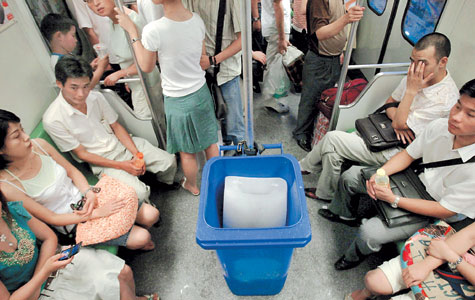
Temperatures in Shanghai are around 37 degrees at the moment, and some of the older metro trains do not have sufficient cooling equipment to cope with the heat. Over the past days reports emerged in local media that passengers attacked train drivers, who they suspected of turning off airconditioning systems in the trains.
But now the operating company became inventive: they put buckets of ice in the trains. I don’t know if this really helps, but at least they are trying. But what will happen during rush hour? Normally trains are so full (you have to literally fight your way in) that I would not be surprised that people are pushed into the buckets by the crowd. At least they will cool off quickly 🙂
(picture from today’s Shanghai Daily)
Online Gaming China 2006 conference
This week I went to the Online Gaming China 2006 conference in the Renaissance Pudong hotel in
(cross-posted on marketingfacts.nl in Dutch)
Fake roofs
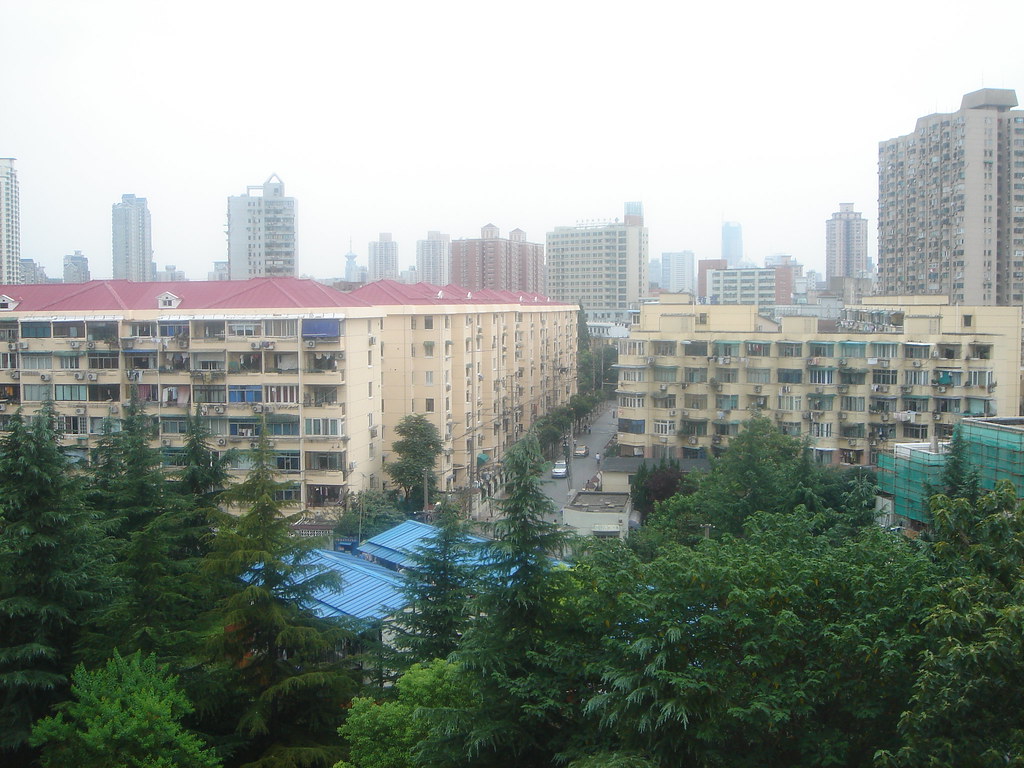
A couple of days ago I took a picture from the building where the new Spill Group Asia office will be located (we plan to move in about 10 days). Suddenly I realized that I had taken a similar picture in March this year, and that the view was quite different then. What happened? Because the residential buildings were so old and dirty, the government painted all of them and put a (fake) red roof on top. See the result for yourself, look at the buildings on the left side of the picture (first old, then new):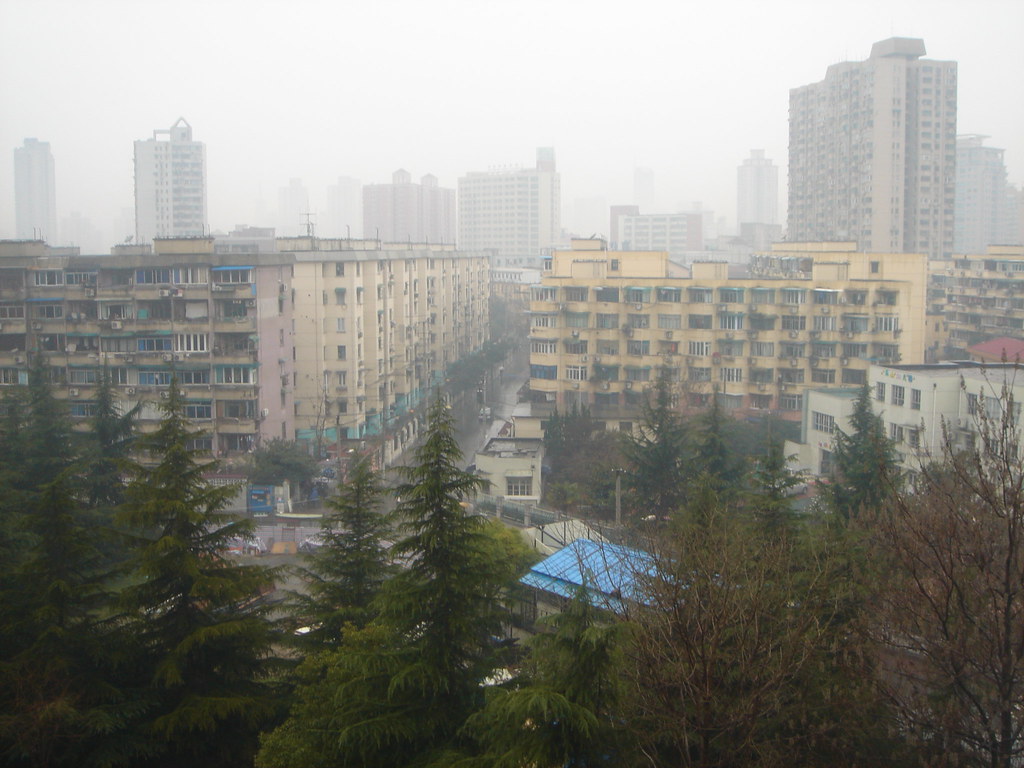
Crowded Tibet
I was doing some research on a trip to Tibet for friends that plan to travel there in August. But it seems that this is not the best time to go there. The reason: the newly-opened Qinghai-Tibet railway (the highest altitude trainride) encouraged a lot of Chinese to make the trip to Lhasa, and tickets are sold out long in advance. Not that my friends wanted to travel by train, but the problem with all these additional tourists is that also all hotels in the city are fully booked (occupancy rate is 97%, which in reality means that you cannot get a room). And even if you have a room you might still not be able to see the tourist attractions. The famous Potala palace only allows 2300 people per day inside its walls. No problem in the past with just a few flights per day, but now that trainloads of tourists are arriving this is not enough.
The Shanghai Daily had an interesting article about some of these tourists. It turned out that many booked sleepers with travel agencies (the overnight trip from Xining is 27 hours), but ended up getting hard seat tickets. Some cancelled the trip upon hearing this. Several travel agencies are now canceling their package tours, because they cannot guarantee train tickets. Tourists also do not realize that Lhasa is located over 4000 meters high, and that this can cause altitude sickness. According to the newspaper, tourists that unexpectedly got sick then tried to claim money from their accident insurance company, but of course they were turned down.
Likely the surge in travel to Tibet will reduce once the summer holiday is over (and once this kind of article appears in more newspapers), but for the next couple of weeks I would stay away from a trip there. A good alternative could be Western Sichuan, the area to the west of Chengdu, which is quite similar with a very wild landscape and many Tibetan monesteries. Maybe not exactly the same, but at least much easier to reach (you can rent a 4WD from Chengdu, or even bike there if you are adventurous), and certainly much quieter!
Continuing fast internet growth in China
Yesterday CNNIC (China Internet Network Information Center) presented its half-yearly report about internet usage in China. Again the amount of users has grown significantly, and according to this report China now counts 123 million internet users. This is an increase of 19.4% compared to last year. Last year the growth was 18.4%, so even the growth speed is still going up. China is the second country world-wide based on internet users (number 1 is the US with 147 million users).
Because China’s population is 1.3 billion people, 123 million is not that much yet: 90% of the population is still offline. This leads to huge growth chances for internet companies. Because 82% of all internet users is younger than 35 years, entertainment is still the most important internet activity. Online gaming and watching video’s take a bigger share of the time people spend online. This is also helped by the fact that the broadband penetration increased from 45 million users last year to 77 million this year. The average Chinese spends 16.5 hours per week online (as a comparison, in Holland this is less than 5 hours per week).
Next to entertainment people also buy more products online. Of the 123 million internet users 30 million purchase goods on the internet, an increase of 50% in comparison to last year. Also internet education is getting more popular, at this moment 15 million people are doing courses online.
The report (in Chinese) can be found here.
(cross-posted in Dutch on marketingfacts.nl)
Graffitivaganza
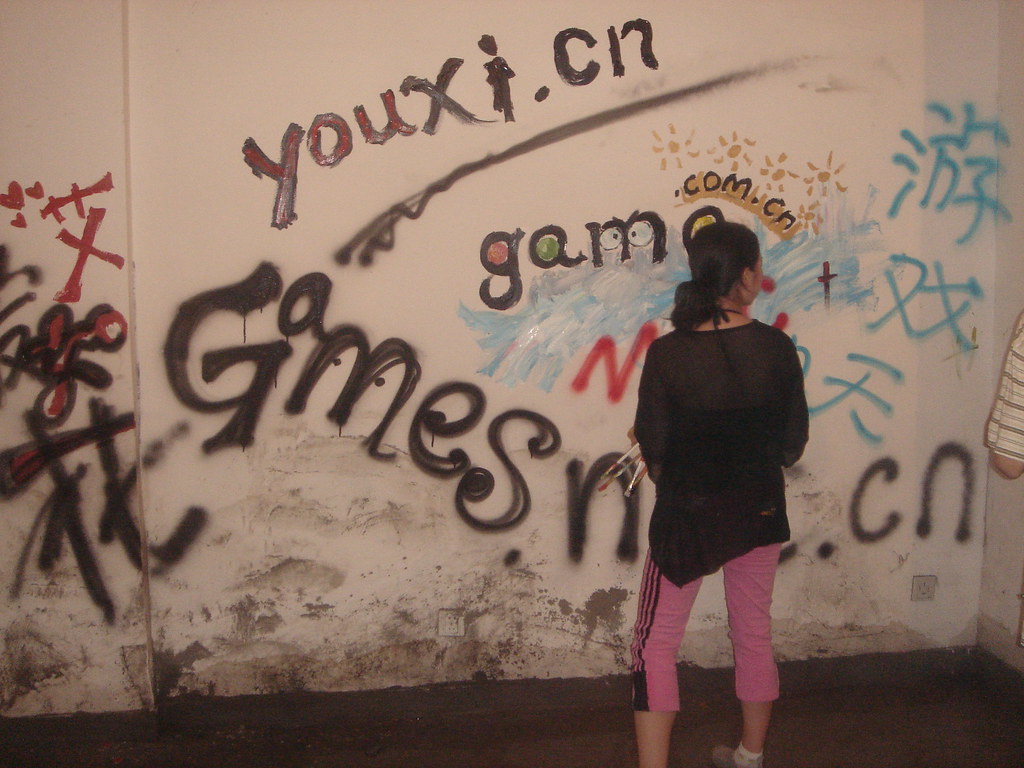
 Saturday’s Toodou party (to avoid confusion I stopped using the name Tudou -with u instead of oo- until the site officially changes its name) was a huge success. Several hundred people came to take a look at the new office, to enjoy the BBQ and to drink free beers. And of course to show their painting talents on the walls (and even on some of the floors…). Most people started on the ground floor that is not in use yet, but soon they moved on to the second floor that had been completely renovated already. And they only stopped when the paint ran out! The office was completely transformed in less than 3 hours, amazing.

It was an enjoyable night, even though I did not get to paint. Luckily the wind and showers from the typhoon had stopped in time for the party, so even the roof terraces could be used. Because the office is so big, some people told me they did not even make it to the roof, because they could not find the entrance. Many of my friends and colleagues showed up, and it was good to meet lots people that I had not seen in a while. Film director David Verbeek was there (I only seem to meet him at the Toodou parties), Rolf Becker from the Shanghai Jazz Orchestra, and even Lei showed up (he was recruited away from Toodou by McKinsey – not a smart move, but that’s his decision).
 I also met many new people, among others two Dutch guys living and working in Shanghai. One of them studied in Maastricht just like me, and he is behind the weblog China Snippets. Also the marketing director for Wall’s ice cream was among the guests, he came with Kenny Bloom (who set up Warner Music in China, and is now running Asiavision). Of course the guys from Shanghaiist were present, and as I read on their blog they discovered a new beer at the party.
Pictures of the party can be found here, or do a search on the tag Toodou on www.flickr.com, where you’ll find pictures from other people as well.