Yamdrok-Tso to Gyantse

I am sitting in an internet cafe in the city of Gyantse, which is supposed to be the third biggest city in Tibet but is actually smaller than an average village in Holland. It’s noisy around me with kids playing online games and watching video’s, and people are looking over my shoulder all the time to figure out what this strange foreigner is doing.

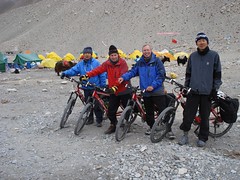
Yesterday we had our third riding day, from the shores of lake Yamdrok-Tso over the Karo-La pass to the foot of the Simi-La. The ride started off quite well, it was about 12 degrees, sunny and there was hardly any wind. But after about 20 km the road became a dirt road, just at the point that the climb to Karo-La started. The road would get worse and worse (luckily we did not know that in advance), until in the end it was so bad that even Toyota Landcruisers had difficulties to ride it. For us on our bikes it was even more difficult of course, but the scenery compensated this. We were surrounded by 7000+ meter mountains, and there was a huge glacier close to the road. Around 12:30 our guide passed my dad and me (we always ride together) in his Landcruiser and asked if we wanted to have lunch. We asked how far it still was to the top of the mountain, and he told us about 3 km. We decided therefore to continue, because that would take us maximum 20-30 minutes. However, it turned out the guide was once again wrong: the 3 km turned out to be at least 10 km of uphill dirt road ride and at 14:00 we finally managed to reach the top (at 5050 meters, not 5500 as the guide had told us – this mistake was something I did not mind).

My dad and I were exhausted because of the long climb and the high altitude, and we could hardly eat anything although we were hungry. It was windy and cold, and we did not feel very comfortable at this extreme height. Right at that moment the second Landcruiser reached the top of the mountain, with in it both Gary and the camera man. The altitude and the bad road conditions were too much for them, and they had to take the car up for the last kilometers. Gary had already had lunch, so he put on additional clothes and jumped on his bike for the long downhill. We followed about 10 minutes later, but after a few minutes later we saw Gary already: he had fallen pretty badly. Luckily he wore a helmet, because that saved him. His helmet was completely bumped, and could not be used anymore. His bike was also not usable anymore, because his gear system was in a mess and his front brake had completely broken off. Gary himself was quite OK, he had some scratches but did not feel to bad. The riding day for him was over.

My dad and I continued, but were very careful. The dirt road was very bad, with lose stones and many holes, and we did not want to end up like Gary. After about 70 km we expected to see the guide with his car at a camping place, but we rode on and on and still did not see him. After about 80 km we were really exhausted (mentally it is very difficult to continue when you are prepared to stop at 70 km) and finally saw his white Landcruiser with the game.com.cn flag on it. When we arrived at his car, however, he told us that he could not find a good camping place and we would have to ride another 3-4 km. Great…. But we had not choice, so we continued on. After about 5 km we saw him again and it turned out there was still no good camping place there. At this point I got really angry. I was totally exhausted and had been riding for 9 straight hours, and I told him that I was fed up with him. A good tour guide should prepare things in advance, which he clearly had not done. I was also angry because he never told us the correct distance, making our rides even more difficult. I know that was not smart, because he was losing face big time (which in Tibetan culture may even be worse than in Chinese culture), but I totally had it with him. We talked it out today (he gave me a good guidebook with distances and altitudes), but I am sure this will be an interesting part of the documentary (yes, everything is being filmed).

The guide drove on to find a camping spot, and me and my dad followed. The problem was, there was still no camping spot. All good spots were demolished because a new road was being built. It was getting later already and we were more and more tired, so finally it was decided to give up the search and drive to the next town, Gyantse. This would have been the town we would ride to today. The idea was to go there and stay in a hotel, and drive us back to the original place in the morning, so we could ride ourselves to Gyantse. However, on the remaining 35 km drive to Gyantse (we rode some of the planned itineray already while searching for a camping spot), we found that there was no road anymore… The old road over the Sima-La had disappeared, and road crews were building a new one. However, this was not finished yet, and our Landcruiser had to cross through mud streams and drive along riverbanks full of boulders. It was totally impossible to ride a mountain bike here, we would probably have to carry it on our backs in order to get through. So finally the decision was made to cancel today’s remaining 35 km because of force majeure, and we would make it up by riding around town today.

That was a good decision, because now Gary could get his bike repaired, and also our bikes could be maintained (unbelievable what 250 km in Tibet can do to your bike, many screws had to be tightened and most gear systems were not working well anymore). After repairing the bikes we did some sightseeing, and we found that Gyantse is a very nice old town. A fairy-tale like fort overlooked the town, and right behind it was a huge, 700 year old, monastery. We spent a few hours there exploring the sights and the old part of town, and it was amazing. Actually, we were glad we have seen, this is something you don’t want to miss while touring Tibet.

Tomorrow we are off to Shigatse (a 95 km ride), where the Panchen Lama has his residence, and where we will stay in a hotel. The day after that we have our first rest day planned, so we will probably do some sightseeing there as well. My wife and Gary’s girlfriend will go back from Shigatse to Lhasa, and fly back to Shanghai from there. After Shigatse it will be a 7 day ride to Mount Everest base camp for us, while camping every night along the road. The first days are behind us, but there are still two weeks of riding ahead of us. I am still very excited!

Start of the bike trip

Saturday morning at 8:30 AM we will start our biking expedition. The plan is to leave from the square in front of the Potala Palace, taking some pictures and then starting the first stage of the tour. Tomorrow will be a 85 km ride, with only one mountain pass to climb (at 3950 meters). We will camp 10 kilometers past the summit, to get used to the higher altitude. The second day looks to be much tougher, when we will go over a 4700 meter mountain pass and later over one of 4400 meters, but the distance will be much shorter. We wil camp at Yamdroktso lake at night, which is supposed to be beautiful. Hopefully there will not be too much snow there. On Monday we will really go into high altitude, when we go among others over a 5500 meter high mountain pass. Luckily we have a descent to 4200 meters right after that, so we should be not too tired when arriving at our next camp location. I am ready to go. Sitting around in Lhasa to do preparations and to get acclimatized is nice, but we are here to bike so that’s what I want to do now. I look forward to the challenge!

Acclimatization

As mentioned in a previous post, acclimatization was a bit tougher than expected. If you should ever go to Lhasa to visit, and you travel by plane, be prepared to feel a bit sick the first days. You can take Diamox (not available in China, so also not in Lhasa) to feel better, but you have to watch out because if you have AMS (acute mountain sickness) you may not see the signs on time. In Lhasa this is normally not a problem, but higher up in the mountains this can be very serious (AMS can be fatal).

My first night was not too good with a splitting headache, and the second was even worse. I did not sleep much because of my headaches, but at least the second night it was a bit easier to breathe. Strange enough I felt quite OK during daytime. The reason is probably dehydration. You have to drink a lot more because of the high altitude, and during the daytime I keep on drinking the whole time (4 liters of water on average). But the second night before going to bed I did not drink much, I figured I drank enough already during the day. This may have been the reason, because last night I decided to drink two bottles of water during dinner, and now I felt fine. No headache at all. I still woke up a few times because I did not get any air, but then you just take a few deep breaths and you are fine again.

Today is the third full day in Lhasa, and I feel we are all used to the altitude now. This morning we rode about 10 kilometer on our bikes, and none of us was out of breath. My heartbeat was a bit higher than normal, but nothing to worry about. It seems we are ready for the trip!

Lhasa weather

The strangest thing about Lhasa is the weather, probably because the city is located so high in the mountains. It can change completely within an hour, and that has happened a few times in the past days. Yesterday is a good example, when we woke up it was cloudy but dry. Soon after it started to rain a bit, and that turned into light snow around 10 AM. Within 20 minutes the snow actually became quite heavy, and it was freezing cold outside. Then at around 12, when we just finished our finished our visit to the Potala, the snow stopped and the clouds started to break. Within an hour the temperature had risen to over 20 degrees! Later in the afternoon it became even warmer and we had drinks at a rooftop bar in the old town. At night after dinner when we wanted to take a taxi back to the hotel, it suddenly was very cold again and it started raining. The whole day there was hardly any wind, but while waiting for the taxi the wind suddenly picked up. Today it’s sunny again, but windy, and about 13 degrees. But the weather forecast that we received this morning said it would snow again. Strange weather.

Tibet, here we come!

Today is my last day in Shanghai before we are off to Tibet. Sean, one of our camera men, is now interviewing some of the Spill Group and Zlong staff for the documentary that they will make about the trip. It will be a surprise for me what they will say about my trip, I will find out when the documentary is finished.

Today is extremely busy in the office, so I don’t have much time to think about what we will be facing in Tibet. On the one hand I really look forward to it, but on the other hand it is a bit scary. Yesterday an experienced biker told us that we don’t have enough time in Lhasa to acclimatize, so likely we will get quite sick. He did not think we would make it. Well, that motivates me to show that we can do it.

My biggest fear right now is the altitude. I have never been so high up in the mountains, and I don’t know how my body will cope with that. I feel I am in a good shape, but that can change very rapidly if the lack of oxygen kicks in. Altitude is something you cannot prepare for, so we will find out soon what will happen.

The next post will likely be from Tibet. In case I don’t have an internet connection it might even be from Kathmandu or worst case when we are back in China around May 17th. Tibet, here we come!

Problems posting to my blog

Since Friday, each time I try to post to my blog through the blogger.com interface, I get strange errors. My ftp server seems to be the reason, I cannot upload pictures and I cannot get my blog published. Quite annoying, especially since I do not have much time to look into it because of my departure to Tibet in less than 36 hours. I am now posting through my email, I hope at least that will work.


Shanghai Auto Show 2007

Today I went to the Shanghai Auto Exhibition during lunch. As a former DaimlerChrysler employee (and currently also freelance reporter for Dutch car magazine Autovisie) I still am a big fan of cars, so each time there is a car exhibition I try go there. The problem with car exhibitions in general, and the Chinese ones in particular, is that it is always extremely busy. But because today the event was only open to the press I could walk around relatively quietly and take a lot of pictures (thanks to DaimlerChrysler for giving me a press day entrance card). The event seemed even bigger than the last ones I have been to, and today’s newspaper confirmed that. The 2005 edition had 1036 car & parts manufacturers, this edition has 1300 exhibitors, and the space increased from 120,000 sqm to 140,000 sqm.

The most interesting thing during this show was to see the quality increase in Chinese vehicles. Of course there were still a lot of low-end cheap Chinese cars, but several manufacturers are moving up very quickly. Especially Brilliance and Chery are doing a good job, with some excellent designs. Others are also making nice cars, but a lot of their vehicles seem to be copies of foreign models. Especially Mercedes-Benz seems to design cars that people like to copy, see also some of the pictures from the Auto Show that I posted here. Another thing that has changed is that there are more and more foreign models standing next to the cars. This used to be only good-looking Chinese women, but now many brands (especially Chinese) flew in foreigners to perform this job.

I had lunch in the Mercedes-Benz VIP area, where I met several former colleagues. That’s always one of the things I enjoy most at these shows, meeting old friends and catching up on how things are going in the company. Being an entrepreneur is great, but being part of a multinational also used to be nice. Especially when you work longer for the company and get a bit higher in the organization people all know each other, it’s a bit like a circle of friends. Most of my friends who are still there have now moved on to senior management positions and several of them are now actually CFO of DaimlerChrysler companies. I also met Wang Ning again after a couple of years, he is now in charge of the commercial vehicle division in China. He just started this job last month, but knowing him a little bit from years ago I think he is the right person for this job. Good to see that DC is more and more localizing its senior management positions, that’s in my opinion necessary to win in China. Also at the Volkswagen exhibition area I met some former colleagues, among others Li Bing (who changed his name to Kevin Li), and who is now a director for Volkswagen China. Many ex-colleagues have moved from DaimlerChrysler to other automotive brands, but not many of them have moved to other fields of business. It’s a small world in automotive China.

Too bad I could not stay very long, because there was still a lot of work waiting in the office (due to the upcoming Tibet trip). Due to all the traffic jams – the negative side of all the new cars in China – it took me almost 1.5 hour to get back to the office. Luckily I had decided to take a taxi and not to drive myself, so I could work a bit in the back seat of the car.

Super Mario birthday present

Virals are interesting. Over the past 2 weeks a Tudou clip with an extremely difficult (actually almost impossible) level of the classic game Super Mario became very popular. For the first time not only in China, but also on the English language internet the clip was sent around. The 23 (!) minute clip has been watched 668,000 times already, without counting the views of copies that were re-posted on the site.

Now there is a second clip featuring Super Mario, that was made as a present for Tudou’s 2nd birthday and the closing of the C-round of funding. Super Mario is the personification of Tudou as you will see, the other Mario’s are the competition. After our A-round the competition increases, after the B-round there is a lot more competition, but now at the C-round many competitors have given up.

Hongjingtian


One of the things Esther and Doris provided us with for the bike trip to Tibet, is a huge amount Hongjintian. I never heard about the product until yesterday, it is a Tibetan herbal medicine that should prevent altitude sickness. I am always a bit skeptical about taking medicine, so I did a Google search. There are not a lot of pages about it, and there is not even a Wikipedia entry yet (quite unusal nowadays), but it turns out it can be quite effective in treating altitude sickness. It also has one very interesting side effect: if you take the medicine your alcohol resistance will be higher (your can drink more before you get drunk).

Over the past days I have read a lot of English language articles about altitude sickness and hypoxia (deficiency of oxygen in your body), but none of them mention Hongjintian. Some advise to take Diamox, but this can have some serious side effects. Is the Hongjintian medicine not known outside China, or is Tibetan medicine not (yet) accepted in the Western world? It is possible that this product might not even be readily available outside China. I found one site with an abstract describing recent medical research with 200 people that were treated for acute mountain sickness. 67% of them either recovered after taking Hongiintian and an additional 30% improved. Not sure how reliable this research is of course, but it sounds almost too good to be true. Anyway, I have started to take the medicine (6 pills per day), and will take it for the next 3-4 weeks until we leave the Himalaya.