
Coyote in Stanley Park

Yesterday I wanted to do run in the evening, but because I had a board call with China at 6:30 PM I decided to do a 12 km run to and around Stanley Park during lunch.

While running on the path around Lost Lagoon I saw a greyish unleashed dog in the distance. I did not see the owner, which was a bit strange. I slowed down a bit and when I got closer I noticed that the dog didn’t wear a collar and looked scruffy. The closer I got the more I realized it actually didn’t look like a real dog and that it might be a coyote…

It seemed to look at me for a short time but then just ignored me. I walked as close to the lagoon as possible, trying not to startle or provoke the animal, and was happy when I passed it (the coyote was probably just 10 meters away from me at one point).

Unfortunately I did not bring my iPhone while running, so I could not take a picture – I probably would not have dared to take a photo anyway. But a quick search online turned up several other sightings of coyotes in Stanley Park over the past weeks, so I am now pretty sure it really was a coyote.
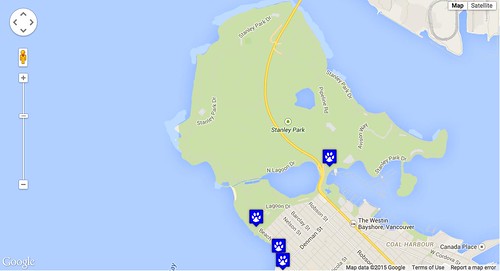
Coyote sightings in Stanley Park (March 2015)

Coyote sightings in and around Stanley Park over the past 2 weeks

When I got back to the office after my 55 minute run – normally I run the 12 km a few minutes slower, I guess the adrenaline rush because of the coyote helped – I went to Google and found out I made some serious mistakes.

First of all you should never approach a coyote if you see one, but slowly back off. In my own defense, I didn’t realize it was a coyote until I was quite close already.

But worse, I then passed the coyote walking as close to the water as possible. My thinking was that in case it would attack I would just jump in the cold water. Well, online I found that coyotes are excellent swimmers and actually follow their prey into the water!

Of course nothing happened because coyotes don’t generally attack humans, especially not when they are on their own (if you see a pack of coyotes it may be more dangerous). It was an interesting experience though and a reminder of how close we are to real nature in downtown Vancouver.

Update (March 19, 2015): I just received an email from the Stanley Park Ecology Society with some interesting information that I partially copy/paste her.

We’ve been keeping a close eye on two coyotes in the West End area as we know that for a time last summer a nearby resident was leaving food out for it at the foot of Nelson Street where it enters Stanley Park. It’s habituated behaviour subsided after the feeding situation was resolved, but the past couple of months the behaviour has been returning likely due to food scarcity and some success in getting food from people. This is most often the explanation for a change in behaviour like this.

 The mangy coyote had been traveling to meet a mate in Olympic village but they appear to have returned together to den down near Burnaby and Bute Street. Based on reports I have received, they have yet to show any aggression towards people or pets, but they are also very comfortable so we do not want their behavior escalating to the point where it approaches people. We are encouraging people to scare the coyotes if they linger in public spaces (mainly for the coyote’s safety) – we are also asking residents to keep an eye out and report any instances of people feeding it or if it shows any aggression. Feeding coyotes is illegal under the provincial wildlife act, and is a ticketable offense, so if we are able to gather enough details on anyone feeding we may be able to act on it.
 

The sudden rise of Meerkat

Meerkat - the future of live video streaming?

Two weeks ago nobody had heard of Meerkat and now suddenly everyone is talking about it (well, at least all the super-early adopters that I surround myself with). It’s quite amazing how quickly this video streaming app has gained traction, despite the fact that it’s actually nothing new. It reminds me of how Twitter’s exponential growth started at SXSW in 2007, and Foursquare at the same show in 2009 (coincidentally this week SXSW takes place again!). Why is Meerkat growing so fast?

For those of you who have not used Meerkat yet, it’s basicaly just a live video streaming app. There are many of these apps but none have really taken off like Meerkat has. Already back in 2008 I was using live streaming app Qik at the Opening Ceremony of the Beijing Olympics. I still remember that because it only worked on Nokia phones and I just had my first iPhone, so the team came to my hotel a few hours before the Olympics started to give me a Nokia phone! Qik was too early, the mobile Internet speeds were too slow and the data still too expensive (or you could not connect to the Internet at all, like happened to me at the Olympics), so they did not take off. Eventually Skype bought them and that’s the last I heard of them.

There were many other live streaming apps, but I didn’t really use any of them until I found Meerkat a few days ago. Suddenly I saw the light, Meerkat did 3 things better than other players. The most important one is that it was built on top of Twitter. When you go to Meerkat and you start streaming, automatically all your Twitter followers will get a message that they can click on to immediately see what you are viewing. This leads to a viral effect, because people retweet the tweet.

The second is the user interface, it is so simple to use it. You can give your stream a title or you just click start, that’s all you need to do. Nothing to set up, nothing to link, it just works. And you can see who is watching your stream and these people can interact with you. Excellent!

The third one is the fact that the stream can only be viewed live, it is not recorded so you can’t watch it again. You can record your own streams and publish them if you want, but that’s not the aim of the app. This may actually lead to a lot more video being streamed, because if something awkward happens only the people who watch it live have seen it. Theoretically they could record their screens, but that’s unlikely, and Meerkat obviously does not allow them to record the stream. This is one reason why Snapchat took off, people seem to want this.

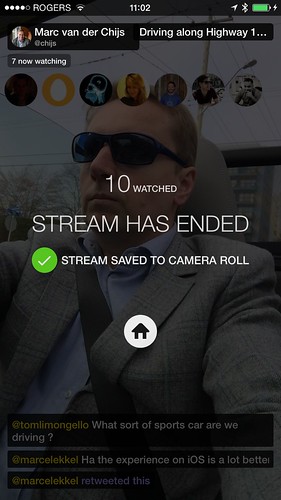
My first Meerkat stream had 10 users!

This morning I decided to try out Meerkat while driving from a meeting to the office. It was a super boring stream, just showing me driving while listening to some Latin music on Sirius XM. I did not say anything and I did not show much of the surroundings. The stream was only about 10 minutes, but during those 10 minutes I had 10 people live watching me drive! If I can generate 10 viewers during such a short time for such a boring video, while most people did not even hear of Meerkat yet, it means this thing has legs.

Suddenly I realized that this could be huge. At any time I can now stream live what I do and the whole world could theoretically watch me. And I have control of the stream, nobody else can post it somewhere for others to watch. I never thought that was important, but I probably would not have recorded myself driving if I knew the stream could easily end up on YouTube.

Is this sustainable? Nobody knows, sometimes apps have huge growth and then they suddenly fade away, see for example Chatroulette in early 2010. But to me Meerkat is more than just a fun app like Chatroulette. It may have found a video solution for the basic Internet need of sharing and showing off. It’s easy to copy and because it’s built on top of another service they depend on them, but if they manage to keep the current traction they have a good chance to become huge. Because of Twitter the service can grow virally, which is a very smart. For sure the timing seems right, mobile Internet is much faster and cheaper than a few years ago and Twitter has almost 300 million active users that can view and share Meerkat’s streams. In my opinion Meerkat may have nailed it.

Twitter just bought Periscope that seems to do something very similar to Meerkat, but if I were Twitter I would offer Meerkat $100-150 million and integrate it into Twitter. Meerkat needs Twitter to grow, so I think they might take the offer. Or they may want a multiple of that, live video is at a tipping point and there are clear business models for this, meaning that this could be worth a lot more than “just” $150 million. An acquisition might lead to huge new growth for Twitter itself, because so far you can only use Meerkat with Twitter. Interesting times ahead, looking forward to following (and using) this app!