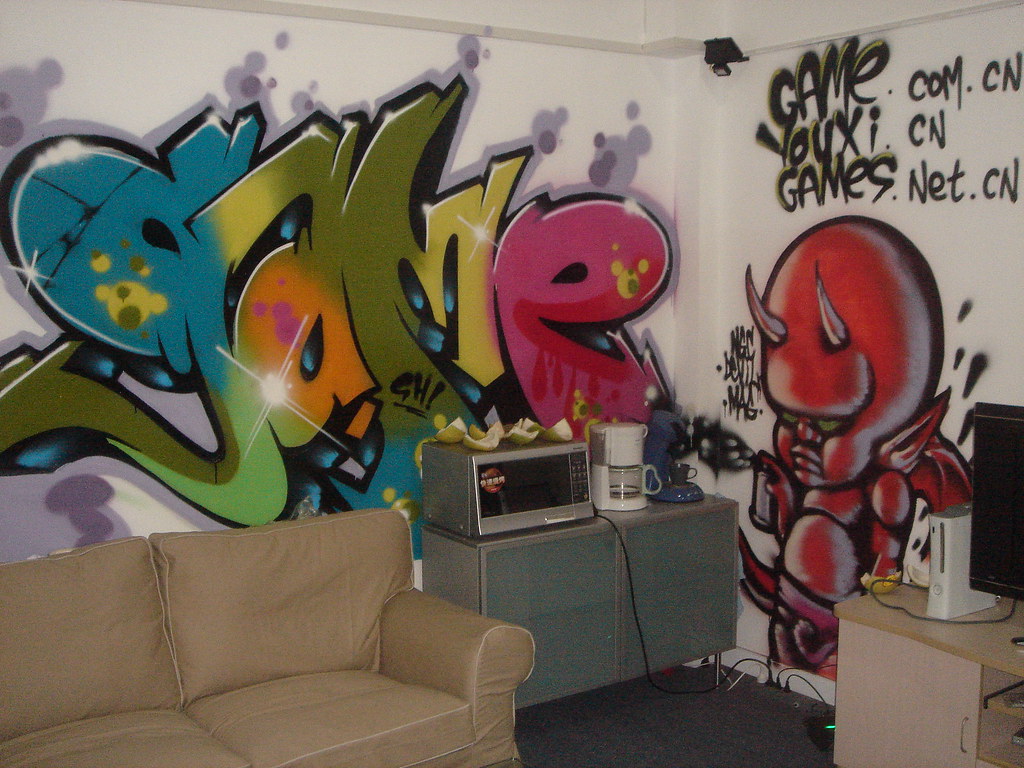
Graffiti @ Spill Group Asia

What do you expect when visiting a gaming company? A silent office with white walls? No, I feel that does not work in this industry. Spill Group Asia’s office is therefore quite lively with among others a recreation room where you can play a game or watch a DVD. And now we also have some great graffiti on some of our walls!

Shanghai Rugby Sevens

Thirty years ago the Rugby 7’s started in Hong Kong, and became a huge success there almost overnight. In its first edition already teams from 7 countries competeted against each other, and this year’s event had 24 participating countries and 40,000 spectators. The event is so big now that hotels in Hong Kong raise their prices during the Sevens, and it’s very difficult to find a room during the weekend of the event.

Last year, Shanghai also started organizing its own 7’s. And this weekend the second edition of what is officially called the Guiness Shanghai International Rugby 7’s will take place. The event is much smaller than the HK version, with 15 teams competing; most of them from China, including one from the People’s Liberation Army. The tournament will take place this Saturday from 9 AM – 5 PM, and Sunday from 10 AM – 4 PM, at the Shanghai Rugby Football Club on Biyun Road in Jinqiao.

In order to attract more people, the entrance is free for Chinese but not for foreigners (they pay RMB 30). A bit strange in my opinion: although RMB 30 is probably less than a beer at the event, principally I feel it’s not right to use different pricing for foreigners and Chinese. Try to do it the other way around, free for foreigners and an entrance fee for Chinese. The whole of China would fall over you (the Chinabounder effect I would call it now 🙂

But segregated prices aside, I hope the event will be a big success and that it will grow into HK-like proportions in the following years. For this weekend 1500 supporters are expected to drink beer and cheer for the teams, if they manage to attract that amount of people I think they are on the right track. Enjoy the games!

A Future Perfect

Most of my Shanghai-based weblog readers probably know that the title of this post is the name of one of the city’s trendiest restaurants. And those not in the know, now know it as well. A Future Perfect is located in a small lane just off Huashan Lu (close to the Hilton Hotel). Not easy to find, but that did not seem to be a hurdle for the place to quickly become one of the most popular restaurants in town. For some reason I had not eaten here yet since it opened last year November, but now I finally managed to go. And I was pleasantly surprised, both by the ambiance, the menu and the prices.

A Future Perfect is a combination of a restaurant and a boutique hotel, located in a quiet lanehouse that was completely remodeled. The design of the place is trendy, almost futuristic. I loved it. There is a courtyard in the back where you can dine alfresco, or just have an after-dinner drink. Because I did not make a reservation, I was lucky to get a table (note to self: book in advance next time I go).

The menu in itself is worth a read. The names of many of their menu items are creative and inspirational, and some really made me laugh. No spoilers here, take a look yourself. The menu is pretty extensive, with lots of fish and meat, to pasta dishes and (if I remember well) even some burgers. The wine list is not a simple list of reds and whites, but they are categorized by the kind of food you are ordering. Great if you are not a connaisseur, or if you just want to try something different – now you know it will fit your food without having to ask the staff.

The food itself was simply great. Sometimes these designer restaurants look great, but their food is just so-so. A Future Perfect manages to combine a great design with excellent food. And even the service was quite OK, something that is often a problem in Shanghai. All in all a nice evening out, for a very reasonable price (dinner for two, starter and main course including two glasses of champagne and two glasses of red wine for around RMB 600). Anything negative? Well, the parking was a bit of a hassle. In the small lane you can park your car, but it is almost impossible to turn around. And avoiding the other cars turned it into an obstacle course. Next time I’ll either park at the Hilton or come by taxi – because I certainly will come back.

Lonely Planet China

Ever tried to buy a Lonely Planet guide for China in China? Forget it, buy it before you arrive in China, because you cannot get it here. I was at Chaterhouse in Times Square last night to stock up on some English books for an upcoming vacation, and was browsing through the hundreds of Lonely Planet guides. I have several old China guides from them, but the last one is at least 4 years old. Because of the unbelievable development of this country, that is probably similar to 20 years in a European country, so I decided it was time for a new edition.

But I could not find the China guide, so I assumed it was sold out. Then I looked for the Beijing guide, and did not find it either. The Tibet guide maybe, as as preparation for next year’s bike trip? No luck. I asked the shop assistant, and he explained to me that in China it is not allowed to sell the Lonely Planet guides for China, Beijing and Tibet.

I never heard this before, but it’s probably true. Of course this is not very unusual because more foreign publications are banned here. But on my way out I noticed that the Shanghai Lonely Planet was on display near the entrance. Interesting, so this guidebook is available for sale. I wonder why?

Google Image Labeler: more than just a game?

Yesterday Google launched Image Labeler, a game in which 2 random internet users are asked to tag (label) a picture. If both players give the same tag, they both get 100 points, and they will get a new picture. If the picture is too difficult or not clear, you can click on pass for another picture. Each games lasts for 90 seconds.

The game is based on the ESP game from Luis von Ahn, who licensed the game to Google. De idea behind the game is that if two people give an identical tag to a picture, the tag must be viable, so that Google can use it in its search results. Possibly they even have an algorithm that only if more than two people use the same tag it will be used. I assume that non-matching tags are also stored, and will be compared to tags that other players give to the same picture.

It seems like a smart move from Google to use the power of the internet population to do some work for them – for free. But will it really work? It of course gives Google the possibility to get all its pictures in its database tagged for free. This should give a Google image search in the future even better results. The question, however, is whether the answers will all be good enough. After playing the game several time I noticed there is a much bigger chance of getting a match when you just type in the main color of the picture. Also it does not make much sense to to use difficult words, because other players also do not do that. Simple words like ‘people’, ‘book’ or ‘blue’ have the biggest chance of earning points. That’a weak point in the system, that could be solved by giving higher points for more difficult or double words (‘space shuttle’ instead of ‘space’ or ‘rocket’)

Another weakness is that a lot depends on your partner. Many game players seem to be not too smart, they give a pass at simple pictures, or only type ‘car’ when they see a picture of a car after 10 seconds. This is a bit irritating, but sometimes you have a partner who seems to think the same as you do, and suddenly you get 10 matches within a minute. An algorithm that puts stronger players together (in which a stronger player is one who scores higher than average), should make the game more interesting, and therefore better for Google.

This algorithm would also ensure that people would play the game for a longer period of time. Now there is no real incentive to play more often or to get a high score. The only thing you can earn are points, and if you are really good (or are really lucky) you might even reach the top-5. But most scores there are almost impossible to reach, and for the overall high scores you need to beat people who seem to play this game full-time.

But I have to admit that the game is addictive. It’s a bit like a casual game, that you play every now and then to do something different for a few minutes. But small prizes, such as a Google Image Labeler t-shirt or extra Gmail storage (I would play the game 10 hours straight for that), could make the game more succesful.

I look forward to finding out how popular Google Image Labeler will become. Will it appear on popular casual gaming sites as well?

(also posted in Dutch at Marketingfacts.nl)