Roland Berger off-site in Hainan

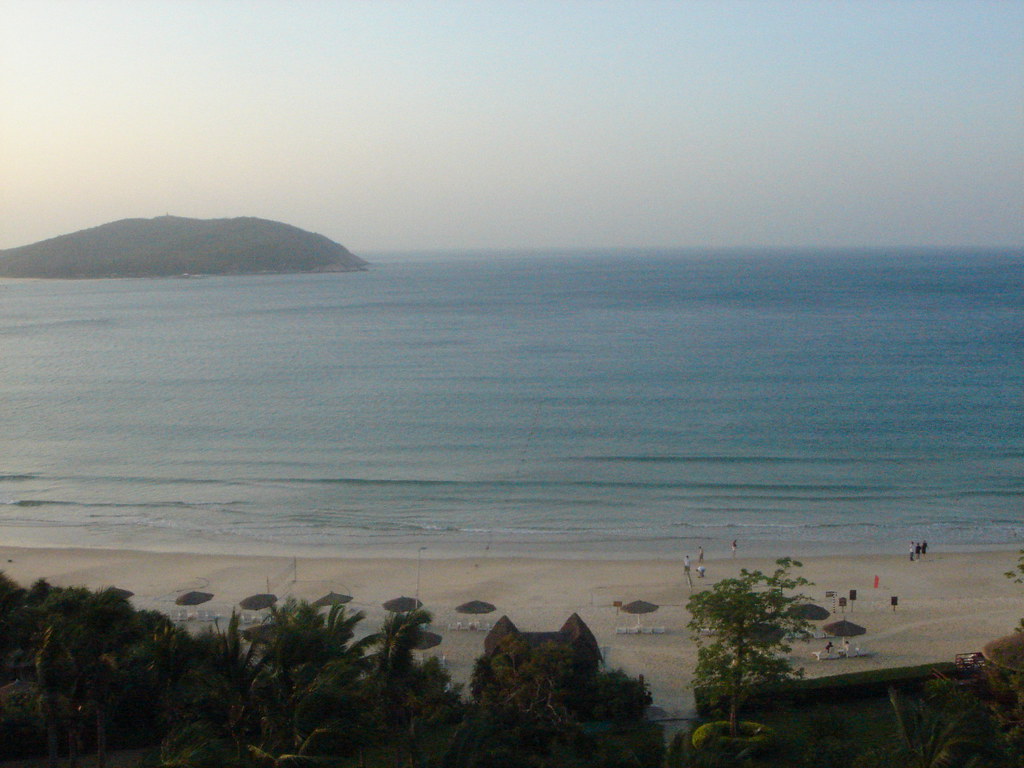
In Sanya on tropical Hainan Island today. My wife has an off-site here from her company (Roland Berger Strategy Consultants) and spouses are also invited. We are staying in the 5-star Holiday Inn Beach Resort, a nice place on the Yalong Bay beach. A good room on the executive floor with a view all over Yalong Bay. The last time I stayed in this hotel was about four years ago when the hotel was still in its soft opening stage. What I still remember from that time is that the staff tried so hard to please the guests, but things always went wrong. It was OK, because we were warned in advance. They are doing a much better job now, even connecting my (English language) Apple Powerbook to the internet was something they managed (it did not find the IP address automatically).
This morning Mr. Roland Berger, the founder of the company gave a pre-breakfast speech (at 7:30 AM, for one hour!). He among others talked about the results of Roland Berger worldwide and compared them to China. The China business is growing very quickly, much faster than the rest of the world (not surprising of course). Mr. Berger is a very charismatic person, and I enjoyed listening to him. Amazing that he managed to build this company in 30 years from a one-man operation to the top 4 or 5 consultancy company worldwide. Based on what he says I feel Roland Berger is a great company to work for. Retaining employees is a major point for them, and they seem to be treated quite well (Qi just started 2 weeks ago, so I cannot judge it yet based on her experience). The only down-side is that the consultants always seem to be working: last night after we arrived in the hotel around 10 PM many people immediately went into meetings, and also today people cannot participate in activities because they need to have discussions.
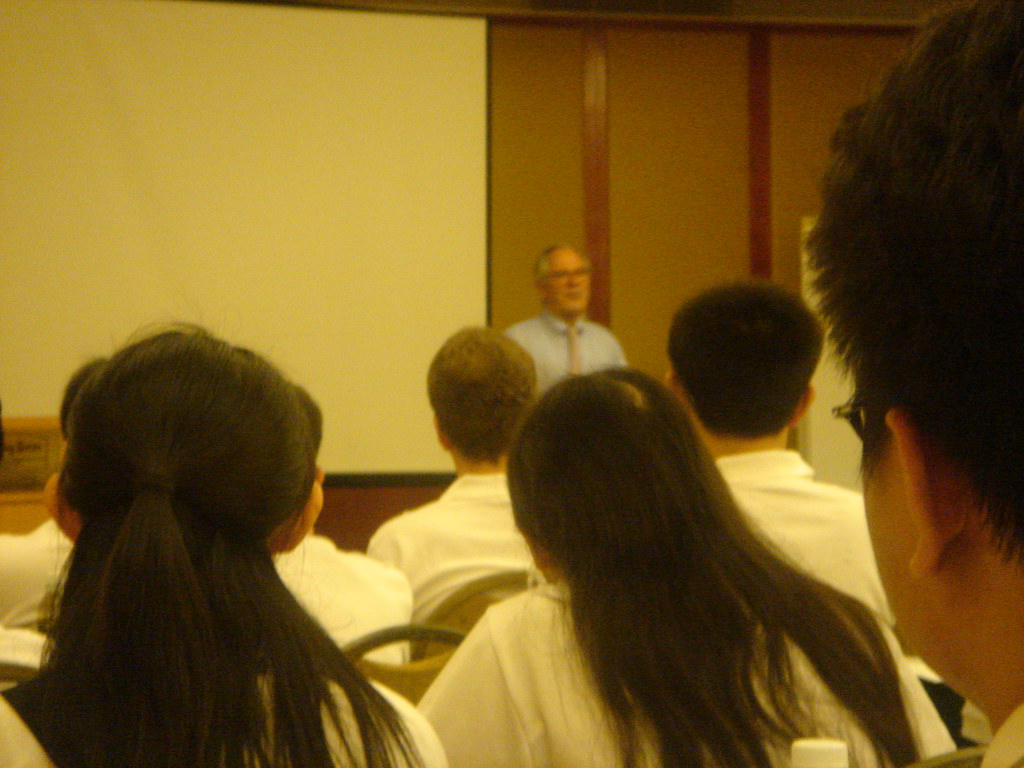
Mr. Berger this morning put it like this: the client always comes first, then the firm, and only then your private life. This is of course not something everyone likes, but if you enjoy your job and feel responsible for the work that you are doing it probably comes automatically. But it also explains why the average age at Roland Berger is not very high: many people change to a different industry after having worked hard and gained lots of experience during a couple of years here. Not necessarily bad, according to Mr. Berger, because they are the best ambassadors for the values and the quality of the company.

New design for Shanghai World Financial Center

The Shanghai World Financial Center, the future highest building in China, will not get the beautiful round hole at the top of the building, as was originally planned. After Chinese complaints that the top looks too much like the Japanese flag, the (Japanese!) developer changed the design to a rectangular opening. To save face of course other reasons were put forward.

Yahoo News:
The developer’s president Minor Mori explained the change by saying that during lengthy planning delays in the 11-year-old project, he began to think the original design had “lost its freshness.”

Construction of the slender, wedge-shaped building began in the mid-1990s and is due for completion in 2008. The original design called for a 164-foot-high circular hole through the tower’s peak to reduce wind pressure on the structure and give it a distinctive profile.

But Chinese critics said the hole resembled Japan’s “rising sun” flag, an image associated in China with Tokyo’s brutal conquest of much of China during the 1930s and ’40s.

F1 Shanghai

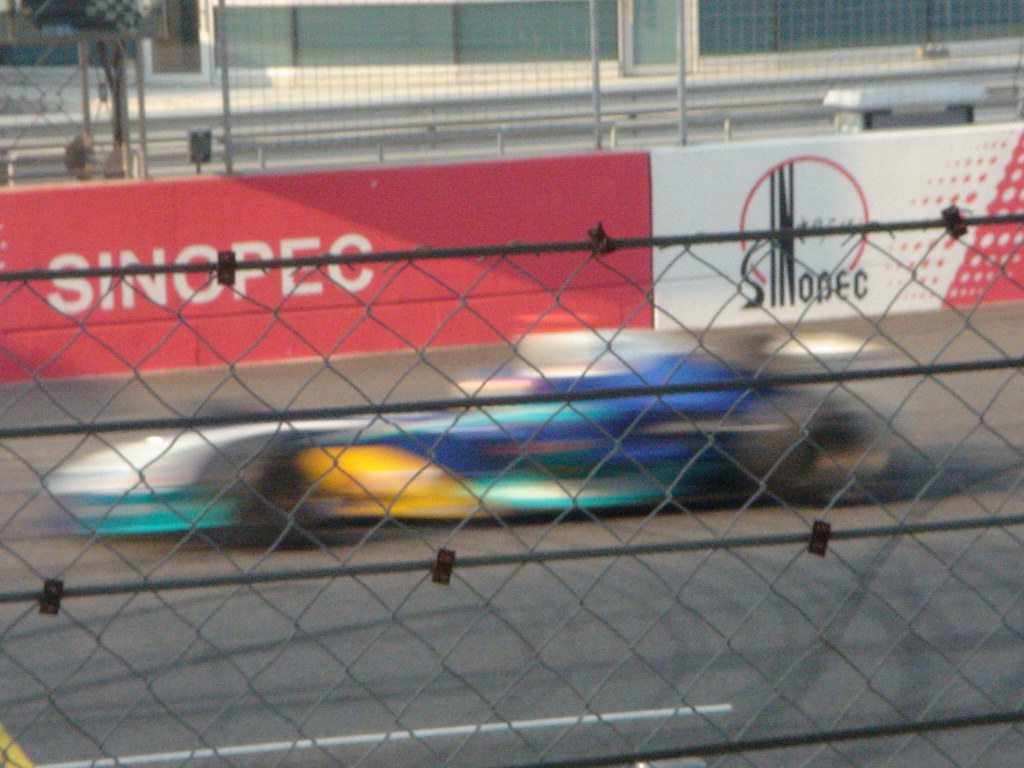
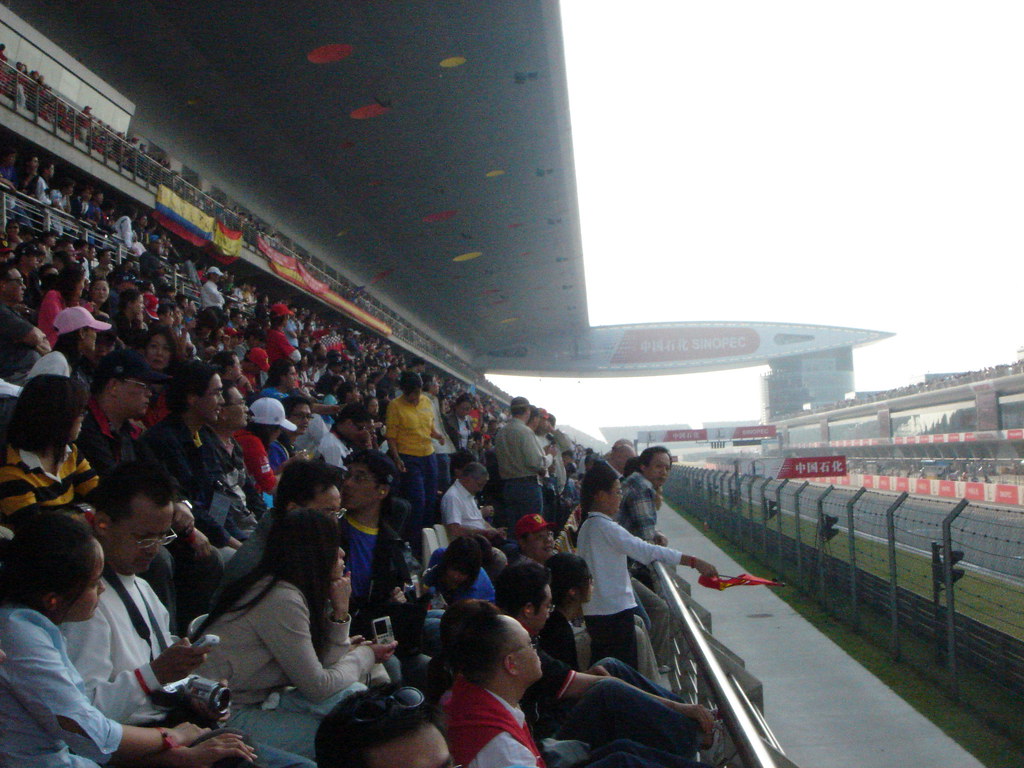
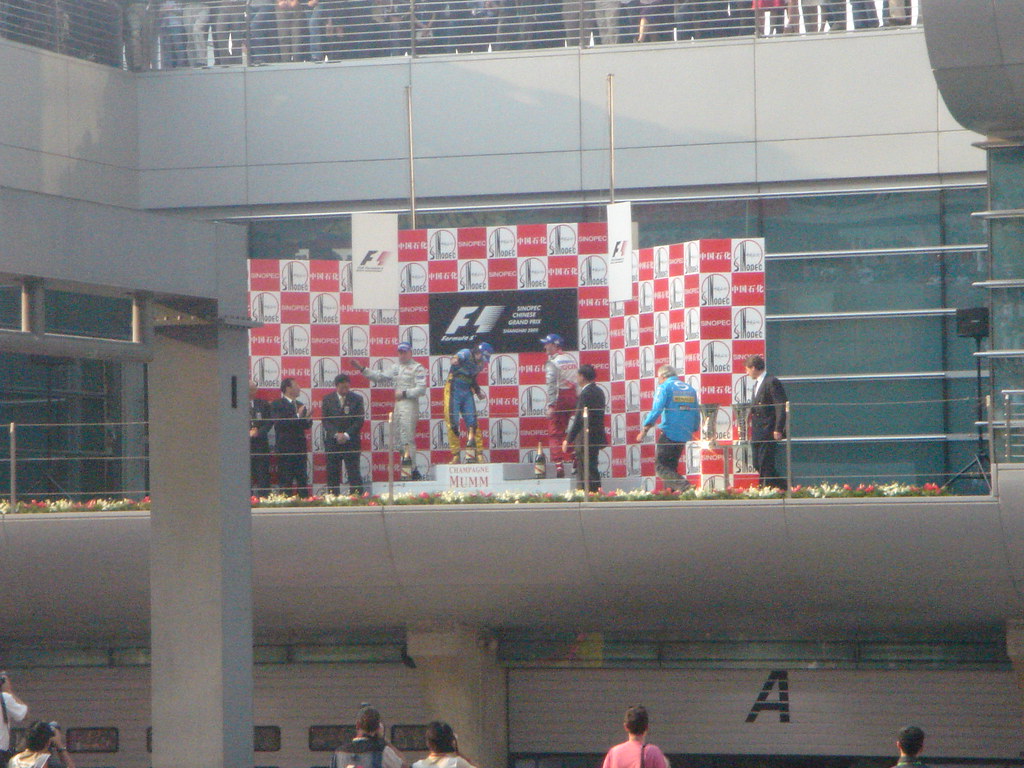
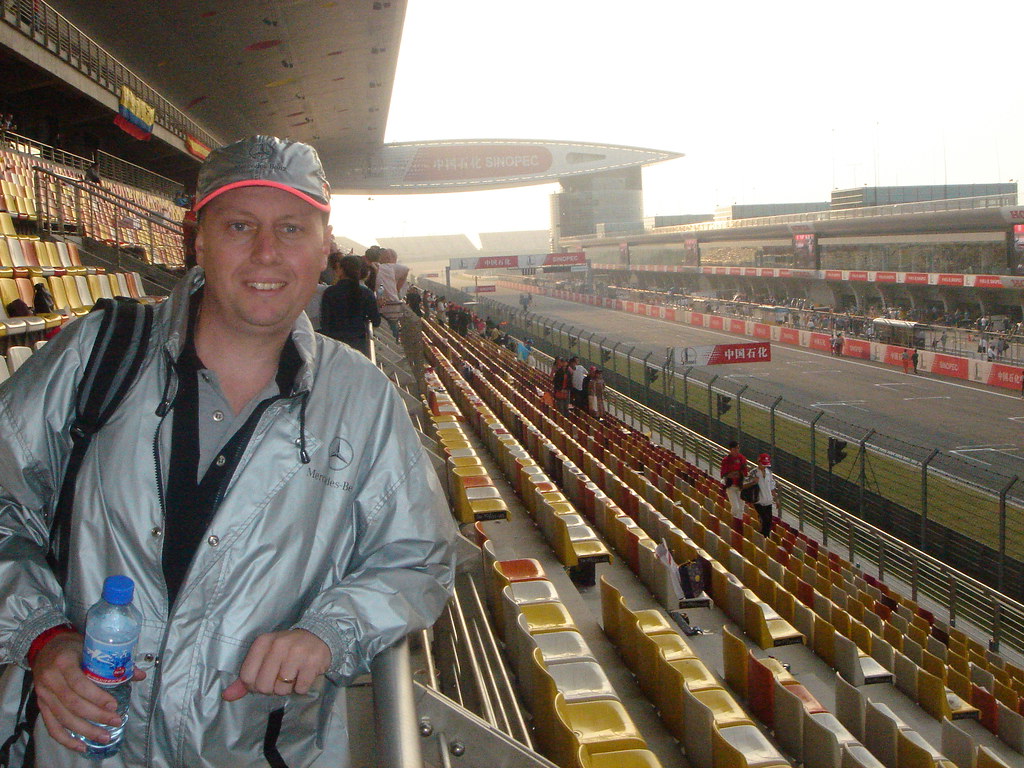
Sunday I watched the Shanghai Formula One race, the last race of the 2005 season. We were invited by Xue Qin from Guanchi / Flirting Pictures, a top local TV commercial production company in Shanghai. She gave us excellent tickets: Row 1 just behind the finish line! The seats were really amazing, being just a few meters away from the cars when they drive by at speeds far over 300 kph is quite an experience. She also arranged that our driver could park right outside the Grandstand, and because of that we were back in Shanghai about one hour after we left the circuit. I guess we were ahead of the traffic jams, because it was quite a smooth ride. Last year we were invited by Bertelsmann to the F1 race, and had a corporate Volkswagen event at the VW test track after the finish. So then we also missed the traffic jams, but many people complained about the long ride back.

Contrary to my expectation, the seats were pretty much filled. In the Grandstand where we had our seats almost all seats were sold out. Outside the Grandstand people were literally throwing money at us to buy our tickets! Quite amazing when you know that Grandstand tickets were almost 4000 RMB (=400 EUR) per seat. I read in the paper that total attendance on Sunday was 130,000 people (a full house is 150,000 people), better than expected a few days ago.


The race was fantastic to watch, although you sometimes miss what has happened (on TV the commenters keep you better informed). Only at home I found out that Montoya had hit a loose drain cover, and therefore had to retire. Exactly the same as what happened at the DTM race in Pudong last year. It seems the organizers did not learn from the mistakes of their DTM counterparts. I also watched that one, and we had to wait for hours before the race was re-started. This time luckily the race continued as planned, but it cost Mercedes-McLaren the constructors title. But all in all it was a great race, especially when you get invited to the best seats in the house!

Matchmaking party

Looking for love in Shanghai? Next weekend there will be a matchmaking party in Zhongshan Park, the Shanghai Daily reports:

“MORE than 4,000 people have signed up to participate in the Shanghai’s biggest matchmaking party in Zhongshan Park on October 22, Oriental Morning Post reported.

About 8,000 love-seekers are expected to join the event.

The five-hour marathon meeting is open to singles between 20 and 45, with at least a high school education. Each participant has to pay 100 yuan (US$12) to register. Their personal details and email addresses will be circulated to other participants. (…)”

And if your company wants to have up a database of 8000 addresses of single young relatively well-educated people in Shanghai, you only have to sign up and pay RMB 100. That’s cheaper and probably more reliable than buying these data through other sources!

Chinese SMS scam

A couple of days ago I heard of an SMS scan in Beijing, that now also has started in Shanghai. The trick is based on the fact that some ATM’s in China can be used to transfer money, and many people do not know this. What happens is that swindlers send out a fake mass SMS saying that a certain amount of money has been deducted from the person’s bank account for a purchase at a shopping center. It also mentions a phone number to call in case of questions.

Some people call the number and are advised to call a special department in the police station, and are given the number for this. The fake police man then asks questions about how much money is still on the account. Then the person is asked to go to an ATM to solve this problem, and call the police number back from there. After doing that the person is asked to push the ‘transfer account’ button and given an identifying code and a cipher code to enter. When that is done things should be OK, the victim is told. But of course that is not the case: the identifying code is the bank account to which the person is transferring money, and the cipher code an amount close to what is still left on the account. In Beijing people were warned for this on TV and by SMS, but still people fall for the trap. The Shanghai Daily reported a case today of a local woman who lost almost RMB 150,000 because of this, but forgot to mention that this practice started in Beijing a few days ago already.

Dan Dan Mian

Note to self: while eating dan dan mian concentrate on eating that, and do not do anything else.

What happened? I was having lunch at the Wanchai restaurant between our office and the Four Season’s hotel. I ordered a bowl of dan dan mian (spicy Sichuan noodles in a red chili soup – my favourite dish), and while enjoying this the Ferrari F1 team left the Four Season’s Hotel. Because we were sitting on the second floor at the window, we had a good view of all the activity going on (many people stopped on the street to watch the team and lots of activity of the bell boys at the hotel entrance while the cars and buses pulled up). I kept on eating while focusing on the activity outside. That was not too smart: my previously white shirt is now covered in Ferrari-red stains. I tried to wash it out, but that made it even worse. Luckily I am not meeting any clients anymore today!

Digital entertainment in China

I wrote the following article that was published in today’s China Daily (CEO Round Table section).


China Daily CEO Round Table

Toodou.com – Digital entertainment from and for China
Marc van der Chijs, co-founder Toodou.com

Toodou.com’s services
In October 2004 the idea was born to set up a Chinese-language website where users could easily publish and download their personal audio and video files. This site, Toodou.com, went live in April this year and became popular very quickly, because of its ease of use and wide variety of available content. Currently the site has about 100,000 registered users, with a growth rate of about 10% per week.

The core digital entertainment services that Toodou.com offers are video and audio files that can be streamed or downloaded automatically to a computer or personal entertainment system (iPod, mobile phone etc.). It offers users a huge variety of different self-made programs, from short documentaries to music videos, and from cooking lessons to people showing their city. People can submit their files and watch programs for free. It can be compared to time-shifted TV or radio: you can listen or watch whenever you want – not only at home, but everywhere you go. Next month Toodou.com will start offering a service to directly stream files to mobile phones.

Infrastructure for digital entertainment
In order for the digital entertainment industry to really take off in China a good infrastructure is essential. High-speed digital networks are a prerequisite for this, especially in the big cities where most people have Internet access. This can be done either by a network of cables or by offering wireless web access all over the city. The government could do this themselves or give incentives to corporations to offer this. Important is that the infrastructure will be cheap enough to use for the average user, meaning low or no user fees.

Speed is important for content that is streamed through the worldwide web. The fact that over half the Chinese Internet population now has access to broadband is a big opportunity. It allows the delivery of higher-quality content with less disruption. The high bandwidth will be an incentive for the entertainment industry in China to further develop applications that require high-speed connections.

In order to get a faster development of the digital entertainment industry it is important that China uses the same standards as the rest of the world. Developing own standards that may work better, may actually hinder the development: The past has learned us that it should not be assumed that the rest of the world will follow once a new, better standard has been developed.

Nationwide Internet access
Although over 100 million people in China have Internet access, this is still less than 10% of China’s population. Out of these 100 million people more than 50 million have at least a college or university degree. Most of these 100 million users are young people living in the big cities on China’s east coast. This means that the distribution of users is very skewed, and that digital entertainment cannot reach a large part of the population. This gap between young vs. old and educated vs. not educated is a challenge that the government could possibly do something about. Just like getting every town and village TV and radio access several years ago, this time the goal can be to get the internet to the countryside. With easy-to-use computers and online teach-the-teacher programs this might be achieved.

Digital future
Toodou.com sees it as its goal to make it easier for Chinese users to find the content and information they are looking for, and to share their films and other programs with the outside world. We think this will help the digital entertainment consumption grow. Eventually we foresee a merger of TV, radio, and mobile phones with digital internet content. Through our site we hope to facilitate this development and prepare China for a digital future.

Link to the article: http://app1.chinadaily.com.cn/focus/ceo/17/perspective.html (scroll down to second article).

Restaurant review: Epicure on 45 – Shanghai's latest revolving restaurant


In the past years several revolving restaurants have been built in Shanghai, among others in the Ocean Hotel, the Jin Jiang Hotel (new tower), the Novotel Atlantis and the Sofitel Oriental in Pudong. The latest one is Epicure on 45, the restaurant on top of the new Radisson Hotel on Nanjing Lu/People’s Square. The building where the Radisson is located was built several years ago, but had been empty ever since (does anybody know why?) until Radisson decided to put a hotel in there.

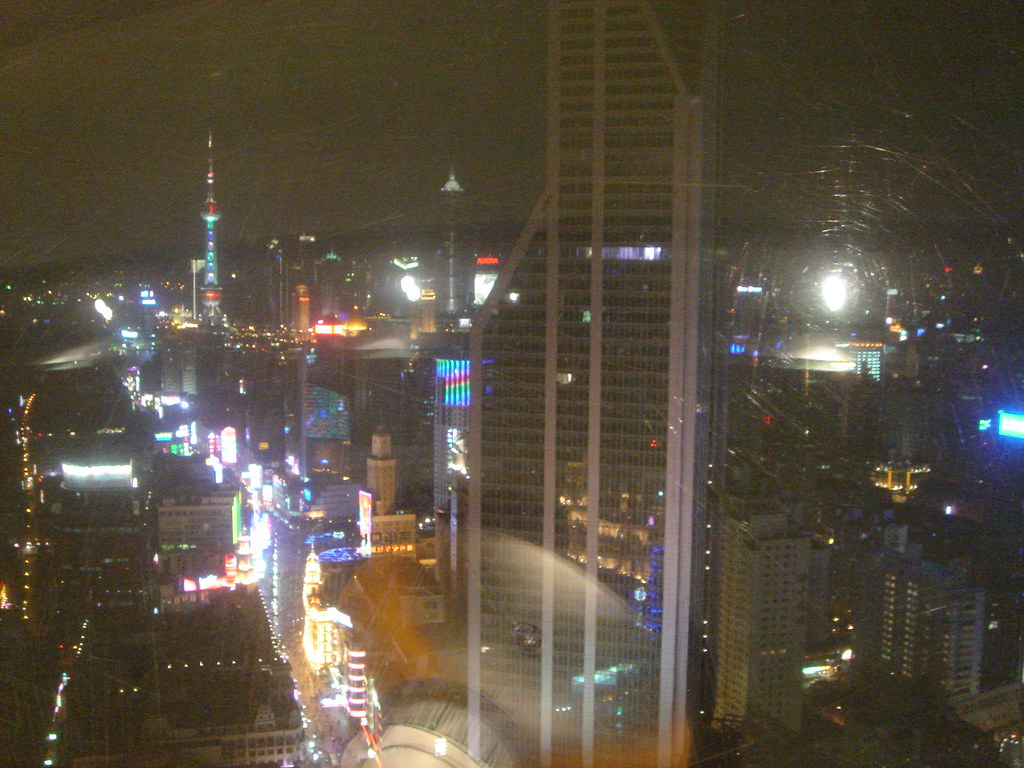
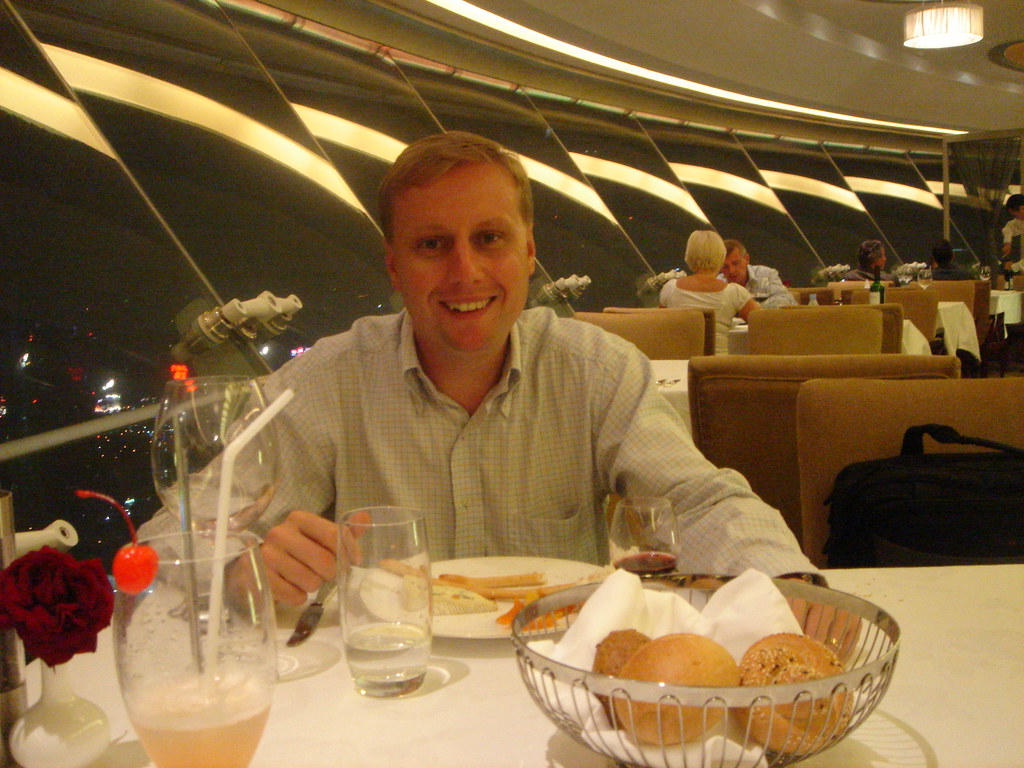
The location is excellent for a revolving restaurant, with views over People’s Square and Huaihai Lu in the south, then Nanjing Xi Lu with the Marriott in the front and Plaza 66 in the back in the west, part of the Suzhou creek in the north (incl. an excellent view of Toodou.com’s new office) and then Nanjing Dong Lu and the Pudong skyline in the east. I had dinner here last night, and had an excellent experience. We were lucky that the sky was very clear, and you could see many miles around (not very usual in Shanghai!). The restaurant turns very slow, we finished almost one turn during our dinner, which lasted from 7 to 10. I am not an expert, but I think that normally revolving restaurants turn in 60-90 minutes. What makes this restaurant special is that you do not only have the view to the outside, but also to the inside: the different kitchen’s all have glass fronts and are located in the middle of the restaurant. This means that during the turn you can see the cook’s in all the kitchens at work.

The restaurant offers Western, Chinese, Japanese and Indian cuisine, and you can choose your starter and main course from different cuisines. We were offered an amuse after ordering our food, something I always appreciate. I decided to have seared foie gras to begin with. It was in one word excellent. Both the taste and the way it was served were great. I combined it with a glass of Australian Chardonnay, which fitted quite well. Qi decided to go for the beef carpaccio, which she also liked a lot. As a main course I had an Australian Beef Tenderloin with a glass of Beringer Pinot Noir. The meat was very tender and cooked exactly right. Qi had cod fish, which also tasted great (I finished it for her; the portions were not small). For desert I ordered a plate of international cheeses (a blue cheese, Edam, Emmenthaler, and a goat cheese – the waiter did not mention the names to me when serving, a small minus), with a glass of port wine. Also this was very good, and I truly enjoyed it.

Any negative points? Not many, although the service could still be improved a bit. The waiters do not speak English very well, which is always a problem in China, and have difficulty understanding what you order. The drinks did not come on time with the food, and the main course was not served for both of us at the same time (for which they immediately apologized). The great food and atmosphere completely compensated this, and I would highly recommend the restaurant to everyone. We paid less than RMB 1400 for the food and wine, which I feel is reasonable for this kind of restaurant and location.