The world’s first Bitcoin ATM opened in Vancouver today

The world's first Bitcoin ATM in Vancouver

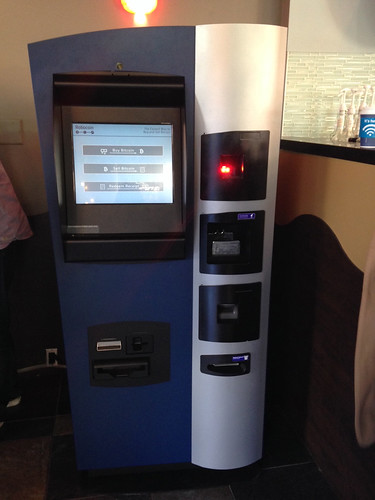
Today the world’s first Bitcoin ATM was placed in Vancouver and of course I had to be among the first to try it out. So this morning I stopped by at the Waves Coffee shop on the corner of Howe and Smithe St. to take a look. There was a TV truck parked on the sidewalk and inside quite a crowd had formed. I was lucky to find a parking spot on the street right in front of Waves, so no need to find a parking garage.
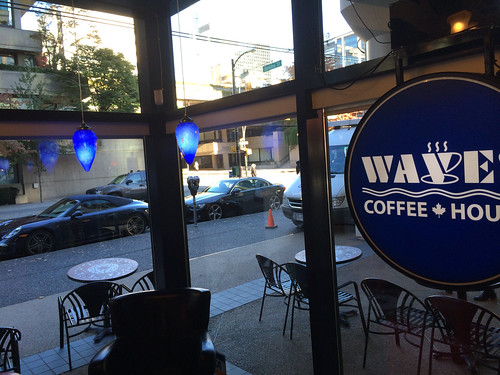
The world's first Bitcoin ATM at Waves Coffee in Vancouver

I went in and saw a mixed crowd of people in their 20s and 30s, plus a lot of media (photographers, TV, traditional journalists and of course bloggers). The line for the ATM was surprisingly short, however. It seemed that most people just came to check it out and may not have Bitcoin wallets yet. After 10 minutes it was my turn and while media were filming and taking pictures I had to scan my hand palm to get started. That took some time, but eventually it worked. But then I got the message that I had to be approved first. I did not want to wait for that and went to the office. After about 30 minutes I received the message that I was approved and could buy and sell Bitcoin.
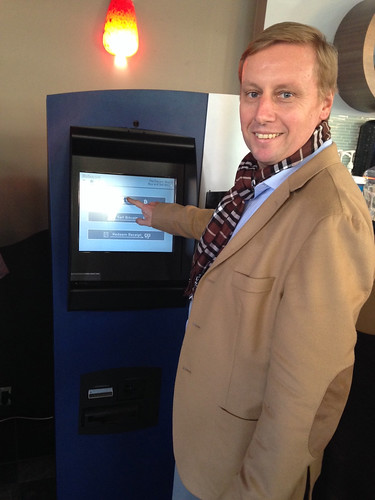
Trying out the world's first Bitcoin ATM in Vancouver

After a lunch meeting I stopped by the ATM again, this time there were just 2 people ahead of me. Strange enough the hand palm scan was not required anymore (I assume most people did not want to wait before doing a first transaction and they stopped the requirement temporarily) and I could deposit money right away. I decided to start with only 20 dollars, just in case something went wrong. It was fairly simple, you push the ‘buy Bitcoin’ button on the touch screen, scan your wallet’s QR code (or put it in manually) and put your money in. You then get a receipt and the money should be in your account in an hour (the money arrived in my wallet exactly 57 minutes after I put it in).
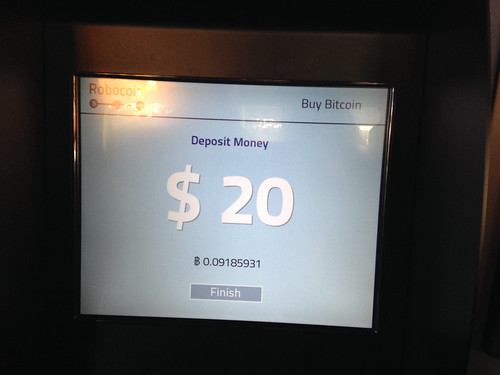
The world's first Bitcoin ATM in Vancouver

The rate that I got was about 1.5% above the actual rate on Mt. Gox ($216 vs. $213), which is okay for me. I did not withdraw any money yet, but I assume there will be a similar ‘transaction fee’. It’s a great service to have such an ATM in downtown Vancouver, and I would be willing to pay even more than this. When more ATMs arrive I assume there will be downward pressure on the fees that are charged.

For me using the Bitcoin ATM was an eye opener: for the very first time I saw Bitcoin as real money, not just money that you can transfer online to pay for things, but money that you can get out of a machine as real bills. So far it has always been virtual for me. Of course I could have sold some of my Bitcoin holdings over the past months and gotten money on a bank account, but now I see actual real money coming out of an ATM.
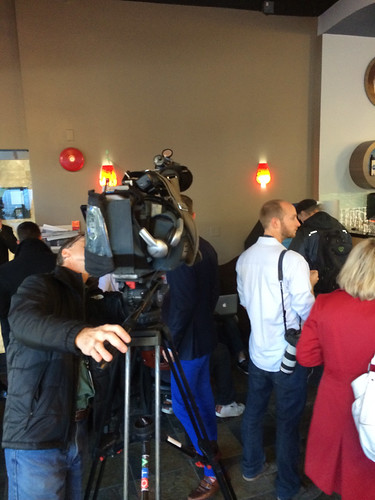
The world's first Bitcoin ATM at Waves Coffee in Vancouver

This is a significant event for the acceptance of Bitcoin, because most people use ATMs already anyway. This is a similar experience to a normal ATM, except that you don’t use a bank card but a QR code of your wallet. Everybody who has a wallet can now buy and sell Bitcoin with real cash! I realized that this ATM is what was missing to make Bitcoin more mainstream. The other thing that’s still missing is a safe and easy-to-use wallet, but I know that several companies are working on this challenge.

If I would be selling these Bitcoin ATMs I would ship them to India or other countries where people receive money through Western Union or through shadow banks. These money transfer services charge 10% or more on transactions and it can take quite some time to receive the money. With Bitcoin ATMs that can be done for a fraction of the cost and in a fraction of the time. There are huge business opportunities that could completely disrupt the banking industry.
Buying a condo with Bitcoin? In Shanghai you can now do it

Although tomorrow the world’s first Bitcoin ATM will be installed in my new hometown of Vancouver, my former hometown Shanghai seems to be the first city where you can actually buy a new condo with Bitcoin. I am not sure if this is just a smart idea to virally promote the project, but a developer now sells small new apartments (42-81 sqm) in Zhangjiang, a hi-tech park area on the outskirts of Shanghai, that you can pay for in the crypto currency. They hope to attract Internet and tech people to live and work there.

The rate is not particularly good though, the developer set it at 1 BTC = 1000 RMB, which is about $164 right now, much lower than the actual rate of above $200 on Mt. Gox. But maybe he just set it a week or 2 ago, during Bitcoin’s fast acceleration? Although there are a lot of tech people around in Zhangjiang that are probably mining Bitcoin, I would be surprised if any of them have accumulated enough coins to buy an apartment.

But you never know, look at this guy in Norway for example. He wrote a thesis about crypto currencies in 2009 and bought for about $27 Bitcoins. He forgot about them and suddenly realized earlier this year that he still had them sitting somewhere in a virtual wallet. At that moment the Bitcoins were worth $885,000 (at today’s rate more than $1 million already), and he bought an apartment right away with part of the proceeds.

China is taking over Bitcoinland

China Bitcoin exchange BTCChina now bigger than Mt. Gox!

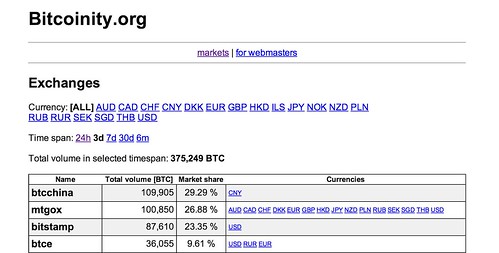
In my post yesterday I mentioned that I had noticed that the price increase in Bitcoins mainly takes place during daytime in China. That could imply that exploding exchange rate is mainly driven by Chinese demand. That theory was confirmed by a table from Bitcoinity that Justin Tsang sent me on Twitter today. The picture shows that over the past 3 days the largest Bitcoin exchange in the world is not Mt. Gox anymore, but BTC China!

Although over the past 24 hours Mt. Gox is bigger than BTC China again, I think this is quite significant for the Bitcoin economy. China is not only taking over the real world, but now also the virtual one. This is something fairly recent, because before I left China earlier this year nobody really talked about Bitcoin yet. Bitcoin is not mainstream yet, but with Baidu now accepting Bitcoin and BTC China being the largest Bitcoin exchange in the world, this is changing very fast!

Bitcoin above US$200!

Bitcoin above $200, what a rally! (Oct. 22, 2013)

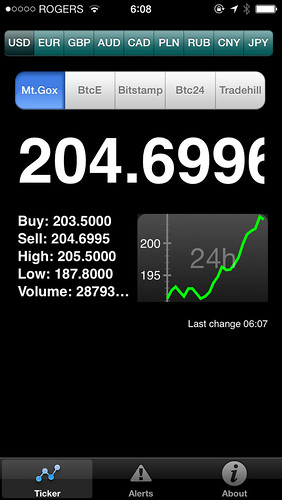
This morning I woke up to see that the Bitcoin/US$ exchange rate is now above $200 for the first time since I started following the crypto currency. It’s almost scary to see how fast it goes up, but the more I learn about Bitcoin the more I think it’s purely demand based. I now have a dedicated Bitcoin app on the homepage of my iPhone and check the rate several times per day, trying to understand whether there is a pattern.

I have the feeling the rate goes up more in the evening/night Pacific Time, which is day time in China. This could mean that the current rally is mainly based on increased demand in China (next to increased demand elsewhere of course). So the short-term risk is not whether the US will ban the currency, but what China will do. I keep on being bullish, although I would not be surprised if their would be a temporary price correction after this huge rally, and will again add more Bitcoin to my portfolio today.

If you are still skeptical about Bitcoin (like most people at this stage), take a look at this wiki with myths about Bitcoin. Very useful information, especially if you are new to the currency.

How do you get readers to pay for a newsletter?

Launch Ticker goes from free to paid

Update: see below this post for an update that Jason sent out on October 30, 2013

In the early days of the Internet newsletters were quite common, but a few years ago they went out of fashion. But at least based on my own usage of them, they seem to be making a comeback, especially ones that curate news. There are a couple of them that I read daily, for example those of some newspapers (The New York Times), one about China (Bill Bishop’s Sinocism) and since a few weeks Jason Calacanis’ latest venture the Launch Ticker.

Even though I enjoy reading them I did not think I would ever be willing to pay for them. Well, in a way I pay for the NY Times one, because it incentivized me to take a subscription to the iPad version of the paper. Several of the others I subscribe to are actively trying to get people to pay, but I wasn’t sure how successful they were to get people to open their wallets. Some are regularly whining about the number of hours it takes to prepare a daily newsletter, others just have a daily ad in there trying to convince you to sign up for a paid subscription.

The threshold of paying is quite high for me, most information I get from newsletters I can also get from my RSS feeds, so why pay for it? I thought about this a lot, because I actually would not mind paying in order to get better content. And as an investor I always look for new or better ways to monetize content.

My conclusion was that I might be willing to pay for newsletters that would save me time (e.g. not having to go through all my RSS feeds) or would show me content that I would normally not see (e.g. translations from Chinese websites or newspapers). However, to stay with the above examples, I did not pay for either the Sinocism newsletter nor for the Launch Ticker, because they are both also available for free. Why spend money if you can get it for free, when there is no real benefit for paying?

But would I start paying if one of the newsletters suddenly would switch to a paid version only? Probably not, I was just not hooked enough to really miss them if they would not end up in my email box anymore. That’s of course a dilemma for content publishers: do you want a small number of subscribers who all pay or more subscribers who don’t pay?

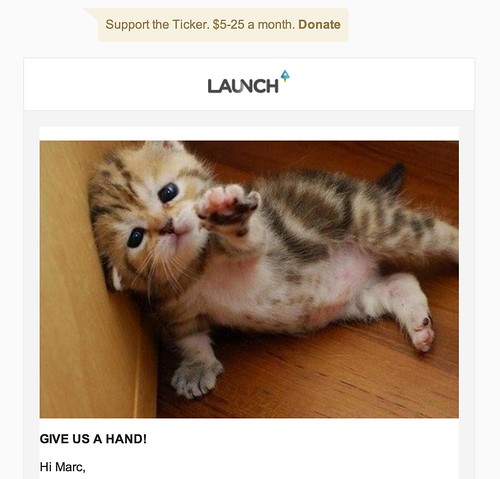
Or is there a middle way? Today I realized there might be, because Jason convinced me to pay a monthly fee to get his twice-daily newsletters. How? Simply by still sending me 12 newsletters a week, but 3 of them with only the title and instead of the content a picture of a sad animal. That’s just genius, you see the headline (that’s normally inviting enough to open the mail) but then don’t get the content 25% of the time. Even though I probably would not pay if I would not receive any newsletters anymore, this method convinced me to put in my credit card details right away. As an added benefit I can now also comment on the Launch.co site, not a major feature but it feels good.

Too bad that the system did not work well yet: after signing up this afternoon I received a sad looking cat when I opened tonight’s email. I assume it’s just a technical glitch and that from now on the Launch Ticker will have only real content.

Great idea Jason, get them hooked and then slowly take the goodies away. I think this might be a good strategy for other newsletters as well and I hope you will share some of the results.

On October 30, Jason sent out the following update & strategy, probably interesting as a follow-up:

Quick update on our #sadpaycat strategy:

1. Every time we replace an email with the #sadpaycat about 25-100 of you become members. When we asked folks to become members in the past without replacing the content of the email we got 1-5. So, it’s at least 10-25x more effective to send a sad cat then ask you to subscribe. 

2. We are now at $2,500 a month in subscribers, or 30% of the budget of this research service. If we get 25 folks to subscribe each time it will take another 60 or so #sadpaycats to hit break even. That’s a lot of sad cats. 

http://launch.co/support

Possible strategy going forward:

a. 100% paid in email, free on the web: We’re thinking of making the email service only available to paid subscribers. 

b. 100% paid in email & web: we’re considering making this service only available to folks who pay. 

c. $10 a month / $99 a year price point: We’re considering making the product $10 a month / $99 a year. If you’re a professional $100 a year is nothing for the value this provides. If you’re broke any amount of money is a bummer. 

At the end of the day the LAUNCH Ticker is a year-long experiment that many important people tell me they love. The mass audience likes the product, the insiders love the product. 

As such we’re going to optimize for the insiders. This means we might run the service down from 20,000 folks a week consuming it to 2,000 paid folks paying $100 a year so we can have two or three full-time researchers. 

Some more thoughts on Bitcoin

Last Friday I was at a Seraph Group conference in Half Moon Bay, south of San Francisco. During the day I talked with a lot of entrepreneurs and investors and I was surprised to see that even among this group most people did not know what Bitcoin exactly is. I don’t think I met anybody who had his or her own Bitcoin wallet.

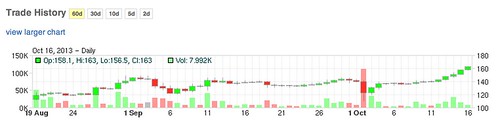
That got me thinking, because I had assumed that Bitcoin would be more well-known by now in Silicon Valley. It’s actually good news, because it means the current value of Bitcoins (at the time of writing $158 on Mt. Gox, so 16% higher than during my last Bitcoin post and 60% higher since my first post about this currency in June this year) is still based on a very small part of the population understanding, holding or using Bitcoin. I keep on being extremely bullish on the virtual currency and keep on putting money into it.

Bitcoin Oct. 16

Since my last post on September 9 quite a lot of things have happened with Bitcoin, the most important being the shutdown of the ‘secret’ website Silk Road (secret in the sense that you had to use Tor to be able to see it, so most people had no access to it). Silk Road was the number one marketplace for illegal goods such as drugs or weapons, and people paid in Bitcoin. The moment the closure was announced the value of Bitcoin dropped to about $100 on Mt. Gox, but within a few days the value was back at the pre-Silk Road exchange rate of about $140. This was an important fact, because it means that illegal activities like Silk Road are not the main reason why people use Bitcoin anymore.

Not only that, it’s also good that Bitcoin will be less associated with shady business deals. It now has the chance to be taken more serious, instead of being seen as something that’s only used for illegal things. Looking back I am happy Silk Road was closed, it was a scary but defining moment for the currency.

Another interesting development is that SecondMarket.com now gives accredited investors the chance to invest in Bitcoin without buying and storing these yourself. For most people holding Bitcoin is still something scary, because they don’t fully understand how it works and they are afraid of hackers. Especially if you put larger amounts into Bitcoin you want to make sure that your money is safe.

Therefore Second Market set up the Bitcoin Investmen Trust where you can buy certificates based on the current Bitcoin rate, and wherre you can sell them again at any time (at least after March 1 next year, until then there is no liquidity). I think this is a super smart idea that I should have thought of myself. I would advise any accredited investor who wants to put more than $25,000 in Bitcoin to look at Second Market, at least until the Bitcoin market will be more developed and wallets are easier to set up and use.

Last weekend David Lee of SV Angel (a well-known investment fund in Silicon Valley) wrote an interesting piece on Bitcoin: 10 Things I Think I Think on Bitcoin. Like me he seems to be very bullish on Bitcoin and he even says that if he would be in his 20s right now looking for a start-up idea and willing to do things others would not be doing (like most entrepreneurs!), he’d spend all his time trying to understand this topic!

David also understands that Bitcoin is much more than just a currency, because that’s just one application of the protocol. This is a fascinating thing and something I only started to see over the past couple of weeks. I won’t try to explain it here in detail, but if you are interested in what you could do with Bitcoin just read this Coindesk article about “colored coins”. Once people start to see this a whole new world of opportunities will open up.

Interesting is David’s observation that Bitcoin has many of the elements of modern “black swan” startups like Google and Facebook (I copy/paste his complete point 5 with some comments):

  • highly polarizing – even and especially among early adopters and ‘experts’; –> I am surprised how many people want to argue with me about Bitcoin, the fact that I am so bullish leads to more heated conversations than with any other investment that I talk about.
  • dismissive or downright hostile attitude by incumbents, usually non-technologists; –> I talked to several banks, but none is able to offer any Bitcoin related services. They don’t even look at this, likely because they dismiss it as not relevant for them.
  • incompatible with and/or pushing against current legal regimes or regulatory systems; –> This is an interesting one, it remains to be seen how governments will react to Bitcoin once it becomes bigger. I believe it’s unstoppable, now they may still have a small chance to stop it from growing much bigger, but that window is closing fast.
  • de-centralized thus involving crowdsourced-based content or activity; –> The whole Bitcoin protocol is based on a decentralized ledger and on the crowd for using and developing applications.
  • false conventional wisdom that the service is only used for illicit or unsavory activity (e.g., everyone thought apps like YouTube, Snapchat, Facebook were used just for porn, hooking up, etc.) –> see Silk Road above
  • unclear business model or applications. –> People only see it as a currency and not as a protocol which could even be used to take companies public without any authority regulating it, or for simple things as giving people a warranty coupon for a TV with a partial Bitcoin.

The more I learn about Bitcoin, the more I am convinced this may be the currency of the future. Today Baidu (the Google of China) announced that they also accept Bitcoin payments now for some of their services. I think that is a major breakthrough. China is already the biggest country for Bitcoin and this will only make it more popular. Theoretically Bitcoin could become a second currency in China, just like Tencent QQ Coins almost managed until it was more or less banned for real world transactions in 2009. The big difference is that Tencent’s currency was managed centrally (and could therefore be regulated), but that Bitcoin has no central authority.

The adoption will likely be very slow, but once the right tools are in place Bitcoin and its applications may be unstoppable. I therefore keep investing in Bitcoin itself, and with CrossPacific Capital we are also close to doing our first Bitcoin-related investment.