Why we can’t solve big problems

I just re-read an excellent article in Technology Review titled “Why we can’t solve big problems”, discussing why the world is not able to tackle big problems anymore like it was 50 years ago. When Kennedy announced that the US would put a man on the moon “in this decade”, NASA indeed managed to send Apollo 11 to the moon – and back. But since I was born (in 1972) nobody has been to the moon anymore. What happened?

The article discusses several reasons, one of them that VCs don’t want to take big risks anymore. To quote the article, “venture investing shifted away from funding transformational companies and toward companies that solved incremental problems or even fake problems . VC has ceased to be the funder of the future, and instead become a funder of features, widgets, irrelevances.” Computers and communication technologies advanced because they were well and properly funded. But what seemed futuristic at the time of Apollo 11 remains futuristic, in part because these technologies never received the sustained funding lavished on the electronics industries.”

My VC experience started about 8 years ago, so I am not sure how VCs did their investments before that, but I wonder if it may partly be because LPs want faster returns? There are so many funds out there that VCs may look for easy returns instead of big problems – big problems with a high risk and many years before returns could be made. Or maybe it has to do with the fact that the investments in big problems would be way too high, and it’s easier to put smaller amounts in smaller companies.

Next to that the (US) government played a big role as well. In the 1960s it was still possible to get the public behind an idea to put a man on the moon, something that would be much harder right now. People feel there are more important problems to solve. Maybe – but only in the short run. In the long run we need to solve big problems to make sure this earth will still have human inhabitants a couple of centuries from now. Maybe China will be the one that will tackle and solve the big problems humanity is facing?

Of course some funds are still working on big issues, one that immediately comes to mind is Intellectual Ventures that has among others developed relatively simple solutions for global warming that were featured in SuperFreakonomics. But generally VCs seem to be focused on apps and simple problems with quick returns.

Another exception is the Founders Fund, a VC fund set up by Silicon Valley’s Paypal mafia (the Paypal employees that got rich after Paypal went IPO). Their motto is the title of this piece “We wanted flying cars, but instead we got 140 characters”. They feel meaningful disruption is necessary, but most founders have no real intent of doing big things. But it may be a chicken or egg problem: do founders not look at the big problems because they know they won’t get funded or because they don’t want to do big things? I think the first part may be more important, because most entrepreneurs that I know want to change the world.

Sometimes disruption also happens by coincidence. Looking back at the founding of Tudou, the initial idea for that company was not to disrupt the traditional way that people consume TV and other visual media (it was actually something similar to what iTunes became for podcasts). You realize the potential of what you are doing only over time and then you start really thinking big.

When the Internet started I don’t think anybody could have imagined the impact it would have on this world. Although the article does not agree with me, I feel the Internet is at least as important as putting a man on the moon. It’s a different scientific field, but the Internet completely changed the way we communicate and how (and how fast) we get our information. The Internet may also help us to solve the big problems we are facing much more quickly.

If you’re interested in this subject you should read the full article here:
http://www.technologyreview.com/featuredstory/429690/why-we-cant-solve-big-problems/


Bonus points for the KLM

I just landed in Amsterdam after the regular 12 hour KLM flight from Shanghai, a bit jetlagged but feeling fine. I mainly spent the flight catching up on emails and RSS feeds, reading 2 newspapers, 3 magazines and part of a book. I’ll mainly be in Maastricht this week where I will give 2 talks, one at the Global Entrepreneurship Week and one at award ceremony for a start-up competition. Always nice to be back in Holland for a few days and especially to be back at my Alma Mater Maastricht University (the University Fund paid for my trip).

KLM has a special this month, where they only serve wines made by Dutch abroad, called “A Touch of the Dutch”. So I got to taste a couple of nice new wines as well, among others a South African Pinotage (Aaldering Pinotage 2009 from Stellenbosch), a Cotes de Bourg (Chateau Beaulieu 2010, Bordeaux), and a young South African Chardonnay (Breedeweelde, Chardonnay Private Collection 2012). I am generally not a big fan of Pinotage, but this was a very nice one (even at 35,000 feet!). The Bordeaux was probably a decent wine, but it had no nose and it wasn’t anything special (maybe because of the altitude?). The 2012 SA Chardonnay was really nice, still very young but despite that very aromatic. Actually not a good combination with the red snapper that I had ordered, but that’s my own mistake (I should have ordered the De Kleine Schorre 2011 instead, but I think I already tasted that one on another KLM flight a few months ago). Bonus points for the KLM for this wine selection!

Reading about myself in a magazine on board a KLM flight to Amsterdam

But the KLM actually deserves more bonus points on today’s flight. This weekend I was featured in an article in FD Persoonlijk, the weekend magazine of Holland’s largest (or better: only) financial newspaper. The interview (about my working style, especially the number of hours that I used to work per week) was done a couple of months ago already and I had totally forgotten about it. I only remembered the photo shoot that took place at Amsterdam Schiphol airport in September during a stop-over from a morning flight from Cyprus to an afternoon flight to Shanghai.

Someone mentioned that the FD article had been published on Twitter on Saturday, but of course I can’t buy the magazine in China. Therefore I tweeted @KLM and asked if they could have a copy on board the flight from Shanghai to Amsterdam on Sunday. They replied right away and indeed the paper including the magazine was waiting for me on the plane. I am often quite negative about the service of the airline, but this was a nice experience. Thanks KLM!

The Beijing Marathon – Not for Japanese…

Beijing Marathon website
A couple of months ago I wrote a post on the fact that sports and politics don’t go together in China. Among others I wrote that the Beijing Marathon would not take place in mid-October because of the 18th Party Congress. I felt bad for the runners who had trained hard for this event, but luckily for them the race was eventually just postponed (Interesting fact: the Party Congress was also postponed, so in hindsight the marathon could have just taken place on its original date).

However, if you are a Japanese national you are out of luck, because the organization won’t let you participate. Officially for ‘safety reasons’, but I suspect that it’s just a case of bullying the Japanese because of the ongoing affair with the Diaoyu/Senkaku islands. It’s really sad that this is happening. To be honest, I probably would not join the marathon if the organizers were stopping one nationality from participating.

I wonder if main sponsor Hyundai (a Korean brand, not Japanese) agrees with the exclusion of Japanese runners. And do the other partners, such as Adidas and Gatorade, know that this happening? It’s a bloody shame if they do and if they don’t pull out because of this.

I went to the Beijing Marathon site to check if it’s really true that Japanese can’t join, but after registering as a user I could not continue the registration process because I did not receive their confirmation email. Maybe they put all registrations on hold because people started complaining to the press?

Because I plan to participate in the Shanghai marathon on Dec. 2, I immediately checked their website as well. The Shanghai Marathon kicked out their Japanese sponsor (they were forced to do so by the government), so I was a bit worried that they would also not allow Japanese to join. But luckily that was not the case, so if you are Japanese and living in China (and you’re not sick and tired of all the anti-Japanese campaigns that don’t seem to stop) you could potentially still run in Shanghai.

Update (Nov. 12): The Beijing Marathon responded and now says Japanese can sign up. They changed it because “Japanese normally don’t sign up individually”. My take: pure damage control, because they didn’t realize that media would pick up this story.

Lending Club and P2P lending, a great investment opportunity

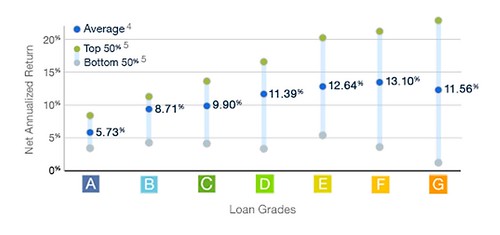
LendingClub logoI am always looking for interesting new investments, whether start-ups or completely different asset classes like wine or real estate. Earlier this year I started researching peer to peer (P2P) lending after reading about Kleiner Perkins’ investment in Lending Club, and Mary Meeker (KPCB partner) and John Mack (former Morgan Stanley CEO) joining their board. P2P lending basically means that you can directly lend money to other people. Sites like Lending Club and Prosper.com facilitate this, by putting borrowers in several risk classes and giving you the opportunity to spread your investment over many different borrowers (e.g. if you invest USD 5000 you could lend USD 25 to 200 people).

When I was reading that returns of around 10% (net) per year are quite normal I thought it sounded too good to be true. Based on my corporate finance background I knew this kind of returns without a huge risk should not be possible in an efficient market. But the fact that some top VCs invested millions of dollars in the company intrigued me. These are smart people, did they see something that I didn’t see?

Returns LendingClub

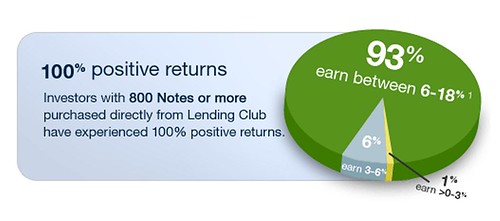
It took me some time, but I finally figured out that sites like Lending Club are actually giving small investors the same kind of returns that in the past only banks could get. The Internet made this possible, because the bank as a middle man was cut out. Because you diversify among many different borrowers you can estimate the default rate in advance, making the investment much safer than it would be when you would just loan to a couple of people. Returns of 10% on their loan portfolio are nothing special for banks, that’s how they got rich and that’s how they finance their huge overhead.

100 percent positive returns at LendingClub

After talking to some people at Lending Club in June this year I decided to “join the club” and put money into a fund run by Lending Club subsidiary LC Adivsors. The advantage of the fund is that you don’t have to decide which loans to invest in, which is something I don’t have time for (or don’t want to make time for). There is a minimum investment for the fund obviously, but if you want to make P2P investment a significant part of your asset allocation you should certainly look at it.

So far my experience has been exactly what I expected, with net monthly returns over 0.7% per month in my portfolio. Service is excellent, with monthly updates and a contact person that I can get in touch with any time. If you’re interested in the fund feel free to contact me by email (marcvanderchijs (at) gmail (dot) com) and I can put you in touch with my contact person at Lending Club.

Of course you can also invest in loans with much smaller amounts, a lot of people seem to start out with a few thousand USD and add a small amount every month. There are a lot of tools out there to decided which loans to invest in, and which doesn’t need to take a lot of time if you don’t add a lot of $$ every month. There are quite some blogs about P2P lending and on how to get started, check out http://www.lendacademy.com/ for a good overview.

The reasons I decided to write this post now is because Lending Club keeps on growing very fast, and announced earlier this week that the company now has over USD 1 billion in person loans and is cash-flow positive, which is a major thing for a fast growing company. Their funds have about USD 250 million under management. If you are looking for an interesting and high-yield investment you should make sure to take a look at p2p lending. Lending Club and Prosper are disrupting the financial market for loans and I think this might become a big industry with very interesting returns for lenders.

Blog migrated to new server

Over the past 2 weeks this blog moved to a new server. I used to host marc.cn at Hostway, but they had too much down time and I wasn’t very impressed by their customer service. So eventually I decided to host it on my own server at Amazon, a bit more expensive but (hopefully) more stable. Of course not everything went smooth right away, but it seems now the blog is working fine again (knock wood…). Thanks for your help in setting up the server and troubleshooting Joop!